

A dental emergency is defined as any oral health condition causing severe pain, uncontrolled bleeding, rapidly spreading infection, or significant trauma that requires immediate professional treatment to prevent serious harm. Understanding what is a dental emergency explained clearly can mean the difference between saving a tooth and losing it permanently. The American Dental Association (ADA) and the Royal College of Dental Surgeons of Ontario (RCDSO) both classify dental emergencies into tiers based on urgency and risk to overall health. At Woodbridgedentalcentre, we see patients across Vaughan, Woodbridge, and Maple who wait too long because they are unsure whether their situation truly qualifies as urgent. Knowing the signs early gives you the best chance at a full recovery.
What types of dental emergencies exist?
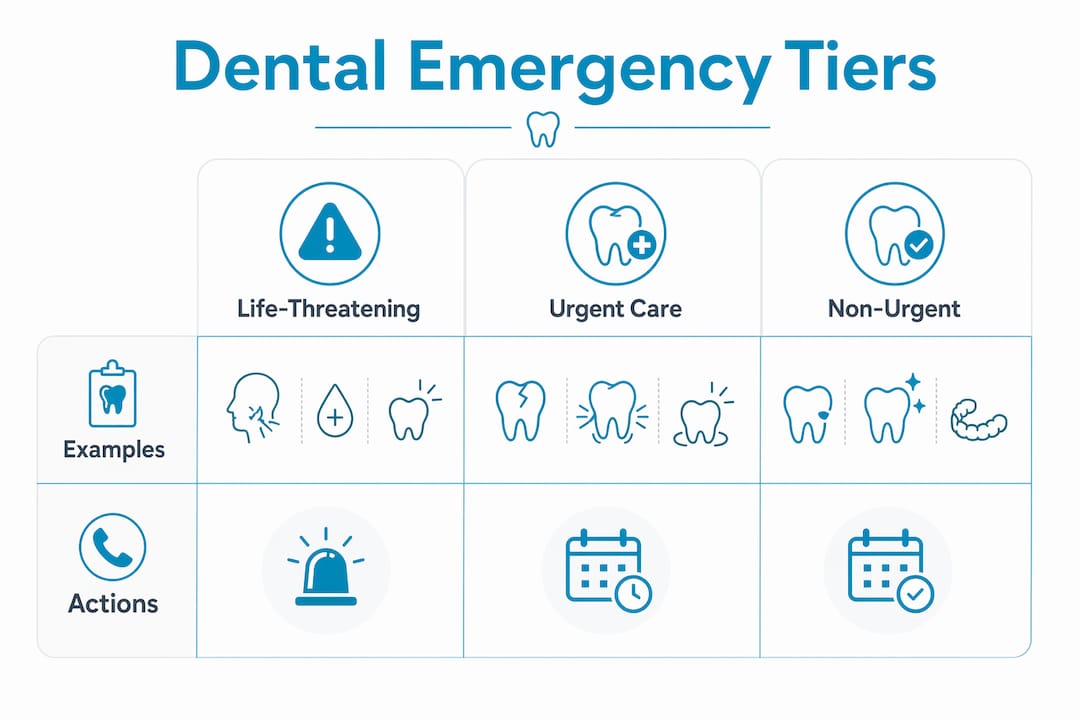
Dental emergencies fall into three tiers: life-threatening emergencies, urgent care situations, and non-urgent issues. That three-tier framework helps both patients and clinicians decide how fast to act and where to go.
Life-threatening emergencies involve airway compromise, severe spreading infection, or difficulty breathing and swallowing. These require a hospital emergency room, not a dental office.
Urgent care situations are the most common dental emergencies. They include knocked-out teeth, dental abscesses, uncontrolled bleeding, severe toothaches, and cracked or fractured teeth. These conditions need same-day dental attention to prevent permanent damage or worsening infection.

Non-urgent issues include a lost filling, a chipped tooth with no pain, or mild sensitivity. These can typically wait one to three days for a scheduled appointment.
| Dental emergency type | Urgency level | Recommended action |
|---|---|---|
| Knocked-out permanent tooth | Critical | See a dentist within 30–60 minutes |
| Dental abscess with swelling | High | Same-day dental visit |
| Uncontrolled bleeding (10+ minutes) | High | Same-day dental visit or ER |
| Severe toothache with fever | High | Same-day dental visit |
| Cracked tooth with sharp pain | Moderate | Same-day or next-day visit |
| Lost filling, no pain | Low | Schedule within 2–3 days |
Many patients are surprised to learn that pain severity alone does not determine urgency. A silent abscess can be more dangerous than a painful cracked tooth. The type of problem matters as much as how much it hurts.
Pro Tip: Not every toothache is a dental emergency. If your pain is mild, there is no swelling, and you have no fever, it is reasonable to call your dentist for a next-day appointment rather than seeking after-hours care.
How to identify a dental emergency: signs and symptoms
The clearest signs of a dental emergency are severe or throbbing pain that does not respond to over-the-counter pain relievers, uncontrolled bleeding lasting over 10–15 minutes, and facial or jaw swelling. A fever above 100.4°F combined with facial swelling signals that an infection may be spreading beyond the tooth. That combination requires same-day care without exception.
Trauma signals are equally clear. A knocked-out tooth, a tooth that feels loose after an impact, or deep cuts to the lips, tongue, or gum tissue all qualify as urgent dental injuries. Children playing contact sports in Vaughan and Woodbridge are especially vulnerable to these injuries, and parents should know how to recognize pediatric dental emergencies before they happen.
Silent infections are the most dangerous category because they cause less obvious pain. A tooth that aches mildly but shows visible swelling or a small pimple-like bump on the gum is likely abscessed. Left untreated, that infection can spread to the jaw, neck, or bloodstream.
Use this self-check list to triage your situation:
- Severe pain that does not improve with ibuprofen or acetaminophen after one hour
- Swelling in the face, jaw, or neck that is growing
- Fever of 100.4°F or higher alongside dental pain
- Bleeding that does not stop after 10–15 minutes of firm pressure
- Knocked-out or very loose permanent tooth
- Difficulty breathing, swallowing, or opening your mouth fully
- Pus or a bad taste coming from around a tooth or gum
If you check two or more of these, call a dentist immediately. If you experience difficulty breathing or swallowing, go to the nearest emergency room. Those symptoms indicate airway involvement, which is a medical emergency.
Pro Tip: When in doubt, call your dental office and describe your symptoms. Most clinics, including Woodbridgedentalcentre, can help you triage over the phone and get you seen the same day if needed.
What to do immediately when you have a dental emergency
Fast, calm action in the first 30–60 minutes can determine whether a tooth is saved or lost. Follow these steps based on your situation.
-
Knocked-out tooth: Pick the tooth up by the crown only. Never touch the root. Rinse it gently with water without scrubbing. Place it back in the socket if possible, or store it in milk or saliva. Reimplantation success drops sharply after 60 minutes, so get to a dentist immediately.
-
Uncontrolled bleeding: Bite firmly on a clean piece of gauze or a folded cloth. Hold steady pressure for 10–15 minutes without peeking. If bleeding continues after 20 minutes, go to the emergency room.
-
Severe toothache: Take ibuprofen or acetaminophen at the recommended dose. Do not place aspirin directly on the gum tissue. That causes a chemical burn and makes things worse.
-
Swelling: Apply a cold compress to the outside of your cheek in 10-minute intervals. Do not apply heat. Cold reduces swelling; heat can accelerate infection spread.
-
Gum infection or abscess: Rinse with warm saltwater (half a teaspoon of salt in eight ounces of warm water) to reduce irritation and draw out some pressure. Saltwater rinses stabilize symptoms temporarily but do not treat the infection itself.
-
Cracked or fractured tooth: Rinse with warm water. Cover any sharp edges with dental wax from a pharmacy if the tooth is cutting your cheek. Avoid chewing on that side.
One of the most common mistakes patients make is relying on antibiotics alone. Antibiotics do not cure dental infections. Physical treatment, such as drainage, a root canal, or an extraction, is always necessary to resolve the source. Antibiotics reduce the spread temporarily, but the infection returns without definitive care.
For patients dealing with sports-related dental injuries, Woodbridgedentalcentre has detailed guidance on first aid for dental injuries that covers both children and adults.
Where and when to seek emergency dental care in Vaughan and Woodbridge
Emergency rooms provide only symptomatic relief for dental problems. They can prescribe pain medication and antibiotics, but they cannot perform root canals, drain abscesses, or reimplant teeth. For the vast majority of dental emergencies, an emergency dentist is the right destination, not the ER.
Woodbridgedentalcentre offers same-day emergency appointments for patients in Woodbridge, Vaughan, and Maple. Dr. Michael Rouhi and Dr. Sandra Farber and their team are equipped to handle abscesses, extractions, root canals, fractured teeth, and trauma cases. Knowing where to go before an emergency happens saves critical time.
Go to a hospital emergency room if you experience any of the following:
- Difficulty breathing or swallowing
- Rapidly spreading swelling into the neck or floor of the mouth
- High fever with confusion or extreme fatigue
- Facial trauma with suspected jaw fracture
- Uncontrolled bleeding that does not stop after 20 minutes of firm pressure
For everything else, call your dentist first. Same-day dental care is almost always the faster and more effective path to relief and recovery.
Regarding costs, private dental insurance typically covers a portion of emergency dental procedures. The Canada Dental Care Plan (CDCP) covers eligible uninsured residents with an adjusted net income under $90,000 for urgent procedures. Verify your coverage before your visit when possible, but never let uncertainty about insurance delay care for a true emergency. Most dental offices, including Woodbridgedentalcentre, can help you understand your options when you arrive.
If you need help booking a last-minute appointment quickly, Woodbridgedentalcentre makes the process straightforward with flexible scheduling and a team that understands urgency.
Key Takeaways
A dental emergency requires immediate professional care when it involves severe pain, uncontrolled bleeding, spreading infection, or traumatic tooth injury, and acting within 30–60 minutes dramatically improves outcomes.
| Point | Details |
|---|---|
| Three-tier classification | Dental emergencies range from life-threatening (airway risk) to urgent (abscess, trauma) to non-urgent (lost filling). |
| Knocked-out tooth window | Reimplantation success drops sharply after 60 minutes; store the tooth in milk and act immediately. |
| Antibiotics are not enough | Physical treatment like drainage or a root canal is always required to resolve a dental infection. |
| ER vs. emergency dentist | Go to the ER only for airway compromise or spreading swelling; an emergency dentist handles all other urgent cases. |
| Insurance options | The Canada Dental Care Plan covers eligible uninsured patients; private plans cover a portion of emergency costs. |
What 25 years of dental emergencies has taught me
In my experience, the patients who fare best in dental emergencies are not the ones who panic the least. They are the ones who act the fastest. I have seen knocked-out teeth saved because a parent kept calm, stored the tooth in milk, and arrived at the clinic within 45 minutes. I have also seen straightforward abscesses turn into hospital admissions because someone waited four days hoping the pain would pass.
The most persistent misconception I encounter is that antibiotics will “fix” a dental infection. Patients take a course, feel better for a week, and then return with a worse problem. The antibiotic reduced the inflammation temporarily. The source, a dead or dying tooth root, was never treated. That is why we always say: antibiotics buy you time, but they do not buy you a cure.
Many patients are also surprised to learn that a dental emergency does not always hurt as much as you would expect. A chronic abscess can be nearly painless while quietly eroding the surrounding bone. If you notice swelling, a bad taste, or a small bump on your gum, do not wait for severe pain to develop before calling us.
The good news is that most dental emergencies, when treated promptly, have excellent outcomes. Teeth get saved. Infections get cleared. Pain resolves. The key is not waiting. If something feels wrong in your mouth, trust that instinct and call. We would always rather reassure you that it can wait than have you suffer through a weekend with a problem that needed same-day care.
— Felix
Dental emergencies at Woodbridgedentalcentre: we are here when you need us
When a dental emergency strikes, you need a team that can see you the same day and treat the problem completely, not just manage the pain.

Woodbridgedentalcentre provides emergency dental care for patients of all ages across Woodbridge, Vaughan, and Maple. Our services include abscess drainage, root canal treatment, tooth extractions, and trauma care for both adults and children. Dr. Michael Rouhi, Dr. Sandra Farber, and the full team are available for same-day appointments, and we work with private insurance plans and the Canada Dental Care Plan to help make care accessible. You can also explore urgent dental care guidance to better understand your options before you arrive. Call us directly or book online, and we will take care of the rest.
FAQ
What counts as a dental emergency?
A dental emergency is any condition involving severe pain, uncontrolled bleeding, facial swelling, a knocked-out tooth, or signs of spreading infection. These situations require same-day professional care to prevent permanent damage or serious health complications.
Should I go to the ER or an emergency dentist?
Go to the emergency room only if you have difficulty breathing or swallowing, rapidly spreading neck swelling, or a suspected jaw fracture. For all other dental emergencies, an emergency dentist provides faster and more effective treatment than a hospital ER.
How do I handle a knocked-out tooth before reaching the dentist?
Hold the tooth by the crown, rinse it gently without scrubbing the root, and place it back in the socket or store it in milk. Act within 30–60 minutes to give the tooth the best chance of successful reimplantation.
Can antibiotics treat a dental infection on their own?
No. Antibiotics alone cannot resolve a dental infection. Physical treatment such as a root canal, abscess drainage, or extraction is always required to eliminate the source of the infection.
Does dental insurance cover emergency visits?
Private dental insurance typically covers a portion of emergency dental costs. The Canada Dental Care Plan covers eligible uninsured Canadians for urgent procedures. Always verify your coverage in advance, but never delay care for a true emergency due to insurance uncertainty.
Recommended
- Types of Family Dental Services: What Every Family Should Know
- What’s a Pediatric Dental Emergency? | Know When to Call the Dentist – Woodbridge Dental Centre | Cosmetic, Implant & Family Dentistry
- How an Emergency Dental Visit Works: What to Expect
- How Dentists Handle Same-Day Emergencies: What to Expect


