Take your child to a dentist within six months of their first tooth appearing, or by their first birthday, whichever comes first. That is the clear guidance from the Canadian Dental Association, and it applies whether your child has one tooth or several. The goal is prevention, not treatment. Most parents wait until they see a problem. By then, early childhood caries (ECC) may already be progressing.
Three things you can do right now:
- Book the appointment if your child has a first tooth and hasn’t seen a dentist yet.
- Do the lift-the-lip check monthly: gently lift your child’s upper lip and look for chalky-white or brown spots along the gum line. Caring for Kids recommends seeking dental care if you see any.
- Gather your child’s health history so you’re ready when you call.
Key Takeaways
The most important thing a Canadian parent can do for their child’s dental health is book that first visit within six months of the first tooth, or by 12 months, whichever comes first.
| Point | Details |
|---|---|
| First visit timing | Book within six months of the first tooth or by 12 months, per CDA guidance. |
| Monthly home check | Lift the upper lip monthly and look for chalky-white or brown spots along the gum line. |
| Follow-up cadence | Most children return every 6 months; higher-risk children may need visits every 3–4 months. |
| Urgent care signs | Seek same-day care for swelling, persistent mouth pain, a knocked-out tooth, or visible brown/black spots. |
| Local option | Woodbridge Dental Centre sees infants and toddlers and offers meet-and-greet visits for anxious families. |
When should you take your child to the dentist?
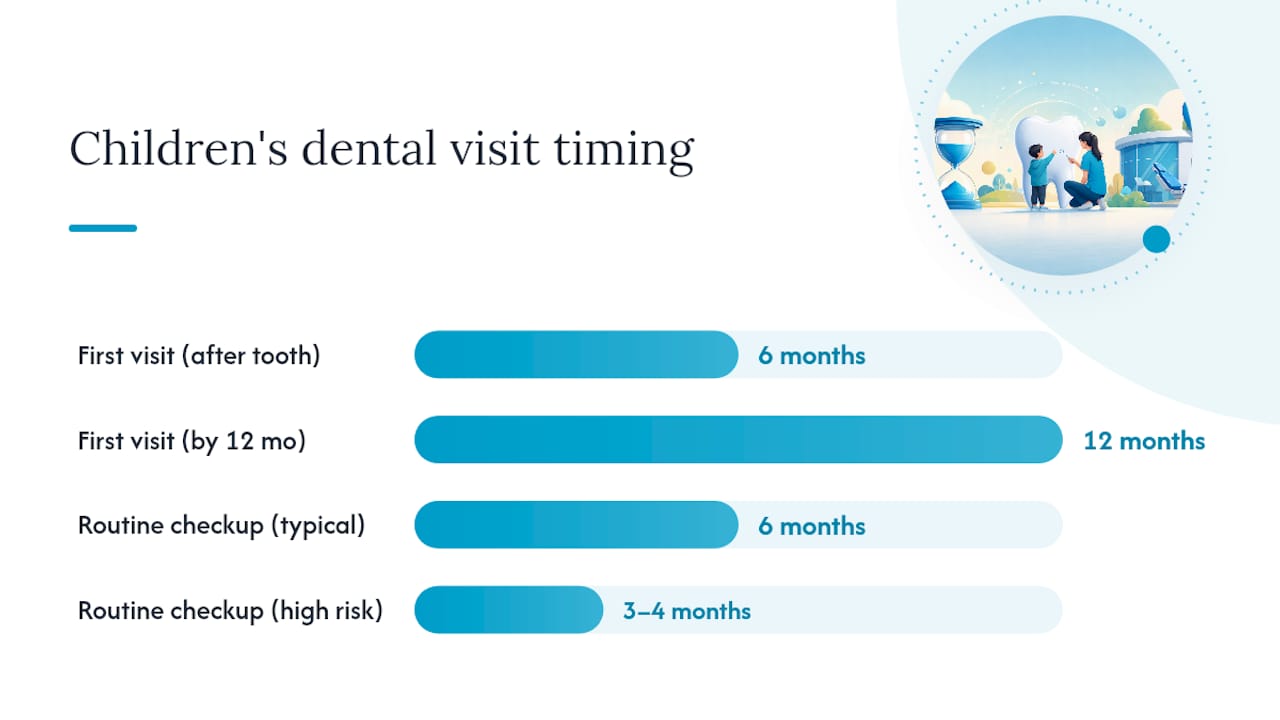
The Canadian Dental Association recommends a dental assessment within six months of the first tooth erupting or by 12 months of age. This isn’t arbitrary. Early visits let your dentist catch enamel changes before they become cavities, assess feeding habits, and give you personalized home-care guidance.
Preventing early childhood caries requires early visits, timely risk assessment, and preventive counselling tailored to your family’s situation. Waiting until age two or three, which many parents do, means missing a window when intervention is simplest and least invasive.
Follow-up visits typically happen every six months. For children identified as higher risk at that first assessment, the CDA’s position on first visits notes that more frequent appointments, every three to four months, may be appropriate. Your dentist will tell you which schedule fits your child after reviewing their history, feeding patterns, and enamel condition.
A few practical scheduling notes:
- Morning slots work better for toddlers. Young children are more alert and cooperative earlier in the day, as Stanford Children’s Health points out.
- Avoid scheduling around nap time or right before a meal.
- Call ahead to confirm the practice sees infants and toddlers.
What are the signs your child is ready for a dentist visit?
The clearest indicator is simple: a first tooth has appeared. That tooth needs professional assessment, regardless of how your child behaves. Readiness for a dental visit isn’t really about personality; it’s about age and eruption timing.
That said, some behavioral signs make the visit easier:
- Can sit still for a few minutes with gentle encouragement
- Tolerates having their mouth touched or their teeth brushed
- Responds to distraction (a toy, a song, a parent’s voice)
- Can open their mouth when asked, even briefly
Physical signs that make an appointment urgent rather than optional:
- First tooth visible (the primary trigger for scheduling)
- Chalky-white spots along the gum line (early demineralization)
- Brown discoloration on any tooth surface
- Active teething with multiple teeth erupting close together
Clinically, those chalky-white spots are the earliest visible sign of demineralization. Catching them early allows non-invasive treatment, such as topical fluoride varnish and improved brushing, rather than a filling later. The monthly lift-the-lip check is the simplest tool parents have.
Pro Tip: If your child resists mouth touching, don’t postpone the visit; many practices offer helpful tips for preparing children for dental visits, such as those at Clayton Dental Studio’s kids dentistry. Many practices, including those serving families in Vaughan and Woodbridge, offer short familiarization visits where your child simply sits in the chair and meets the team. This low-pressure introduction often makes the actual exam much smoother.
What happens at your child’s first dental appointment?
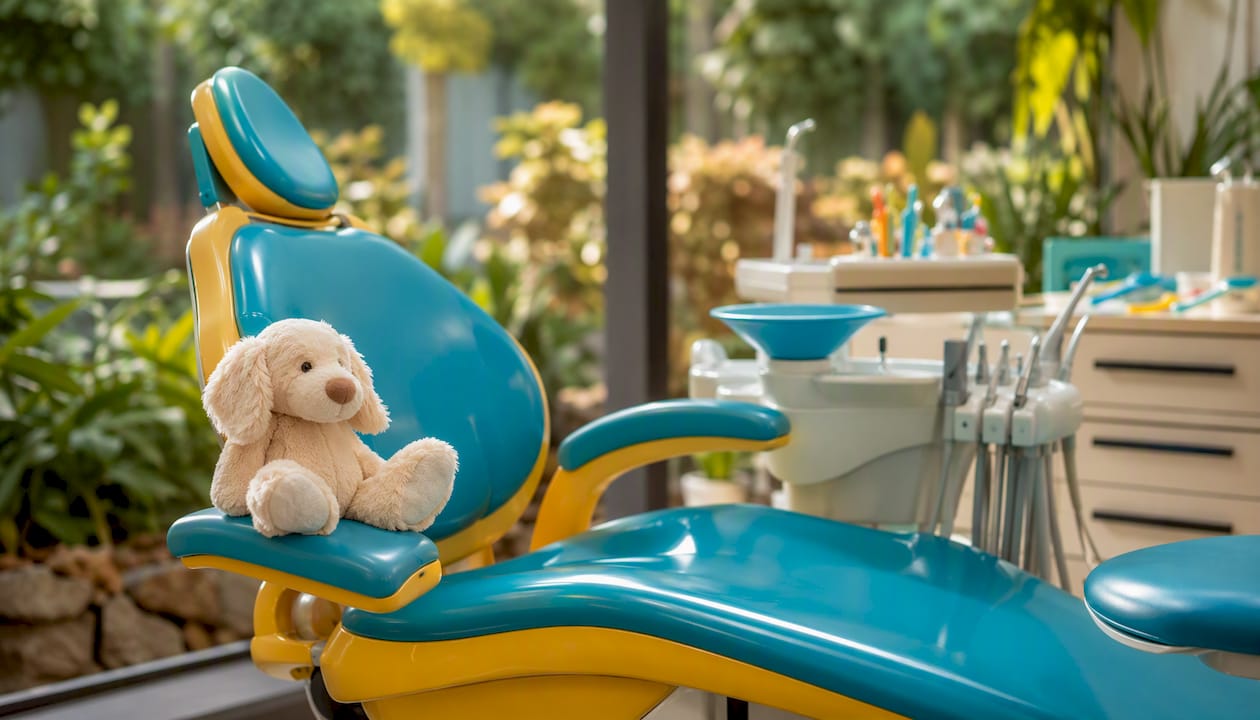
The first visit is mostly assessment and comfort-building. Stanford Children’s Health notes it often lasts 30–45 minutes, though with very young children it can be shorter. You’ll be in the room the entire time.
What the dentist typically covers:
- Medical and dental history review
- Visual exam of teeth, gums, jaw, and bite
- Gentle cleaning or polish if the child cooperates
- Fluoride discussion and possible fluoride varnish application
- Parent education on brushing technique, diet, and home care
X-rays are rarely taken at a first visit for very young children unless there’s a clinical reason, such as visible decay or trauma. The University of Rochester Medical Center confirms this approach: the first visit focuses on assessment and building a positive association with the dental chair, not procedures.
What to bring on the day:
- Your child’s health history (any medications, allergies, medical conditions)
- A list of questions you want to ask
- Your child’s comfort item (a stuffed animal, a favourite toy)
- Your insurance card or coverage information
For a detailed look at what the visit involves, inside a child’s dental visit walks through each step in plain language.
How can you prepare your child for the dentist?
Preparation genuinely increases the chance of a calm visit. A child who has heard the word “dentist” in a positive context, practiced opening their mouth at home, and knows what to expect will almost always do better than one who arrives cold.
Preparation steps to take in the days before:
- Read a picture book about a dentist visit or watch a short, age-appropriate video together
- Practice the “open wide” game at home, letting your child look in your mouth too
- Talk about the visit in simple, positive terms (“The dentist counts your teeth and makes sure they’re healthy”)
- Avoid words like “hurt,” “needle,” or “drill” even to reassure (“it won’t hurt”)
- Pack a comfort item and a small snack for after
Day-of sequence:
- Feed your child a light meal beforehand so they’re not hungry or cranky.
- Allow time for a short rest if your child normally naps.
- Complete any paperwork online or arrive 10 minutes early.
- Stay calm and matter-of-fact when you arrive.
Pro Tip: Your attitude is the single biggest factor in how your child responds. If you’re anxious about dental visits yourself, consider sending your child with another calm caregiver for the first appointment. Children read parental body language very accurately. A relaxed adult in the room makes a measurable difference.
For more calming strategies, techniques that ease dental fear in children covers what actually works in practice.
Which symptoms mean you should book a dental visit right away?
Don’t wait for a scheduled appointment if you notice any of the following. These are signs that something needs attention now, not in six months.
Seek same-day or urgent dental care for:
- Persistent crying or fussiness that seems linked to mouth pain
- Visible facial swelling, especially near the jaw or cheek
- A deep brown or black spot on any tooth
- Chalky-white spots that appeared since your last lift-the-lip check
- A tooth that has been knocked loose or completely out
- Inability to eat, drink, or sleep due to apparent mouth discomfort
- Fever with no obvious cause, particularly alongside swollen gums
The CDA’s position on early childhood caries is clear: early intervention prevents more complex treatment later. A chalky-white spot caught at six months is a fluoride varnish appointment. Left until 18 months, it may be a filling or worse.
How do you find a child-friendly dentist in Canada?
Prioritize experience with infants and toddlers, a clear approach to behavior guidance, and an environment where your child won’t feel overwhelmed. Not every general dentist is comfortable with a 10-month-old in the chair, and that’s worth asking about directly.
Questions to ask when you call a practice:
- Do you see infants and children under 12 months?
- How do you manage a child who is anxious or uncooperative?
- Can we schedule a meet-and-greet visit before the exam?
- What behavior guidance approaches do you use?
- Do you offer morning appointments for young children?
- How do you handle dental emergencies for children?
Red flags to watch for: a practice that pushes treatment at the first visit without explanation, one that won’t allow a parent in the room, or one that has no comfort measures for anxious children.
The CDA’s first-visit position notes that a thorough first assessment includes reviewing feeding patterns, enamel anomalies, and oral hygiene practices, not just a quick look in the mouth. A good practice will ask you questions, not just examine your child.
For a structured list of what to ask before booking, 7 questions to ask before choosing a pediatric dentist covers the full evaluation process.
Pro Tip: A meet-and-greet visit, where your child simply tours the office and sits in the chair with no exam, is one of the most effective ways to prevent dental anxiety from developing. Many practices in Vaughan and Woodbridge offer this at no charge. Ask specifically when you call.
A Woodbridge dentist’s perspective on first visits
In my experience, the parents who worry most about their child’s first dental visit are often the ones whose children do the best. They prepare, they ask questions, and they show up calm. That combination matters more than any specific technique.
Many patients are surprised to learn that children as young as eight or nine months can have a perfectly comfortable first dental visit. It’s brief, it’s gentle, and it’s mostly about getting your child used to the environment and giving you, the parent, the information you need to protect those early teeth at home.
The good news is that early childhood dental problems are largely preventable. The HealthLinkBC guidance on dental care from birth to 16 years recommends cleaning your baby’s gums before teeth even appear, then brushing with a rice-sized smear of fluoride toothpaste once the first tooth comes in. These small habits, started early, make a real difference by the time your child reaches school age.
At Woodbridge Dental Centre, Dr. Michael Rouhi, Dr. Sandra Farber, and our team see families from across Vaughan, Maple, and the surrounding area. We focus on making the first visit calm, informative, and low-pressure, because a child who leaves the dental chair feeling fine is a child who comes back without a fight next time.
Woodbridge Dental Centre welcomes your child’s first visit
Family dentistry at Woodbridge Dental Centre is built around exactly this kind of early, preventive care. We follow CDA recommendations for first visits, see infants and toddlers, and offer morning appointments that work with young children’s schedules.

What families in Woodbridge and Vaughan can expect when they book with us:
- A pediatric-friendly team experienced with infants, toddlers, and anxious children
- Meet-and-greet visits available before the formal exam
- Morning appointment slots for young children
- Straightforward help with insurance questions and paperwork
- A calm, welcoming environment designed to put both parents and children at ease
The next step is simple: call us or book online to schedule your child’s first assessment or a no-pressure meet-and-greet. We’re here to make this easy for your family.
Sources
- Healthy teeth for children | Caring for Kids
- A Child’s First Dental Visit: What To Expect – Stanford Children’s Health
- Health Encyclopedia – URochester Medicine
- Your child’s first dental visit: Canadian Dental Association
- Basic dental care from birth to 16 years (HealthLinkBC PDF)
This article is general information, not a substitute for advice from a qualified doctor. Consult a qualified healthcare professional about your own circumstances before acting on anything here.
FAQ
When should a child have their first dental visit?
The Canadian Dental Association recommends a child’s first dental assessment within six months of the first tooth erupting or by 12 months of age, whichever comes first.
What are the signs a child is ready for the dentist?
The primary indicator is a first tooth, not a specific behavior. Most children can have a first visit by 12 months regardless of temperament, and familiarization visits can help anxious toddlers adjust.
How long does a child’s first dental appointment take?
A first visit typically lasts 30–45 minutes and focuses on assessment, comfort-building, and parent education rather than extensive treatment.
How often should children see the dentist after the first visit?
Most children return every six months. Children identified as higher risk at their first assessment may need visits every three to four months for closer monitoring and preventive care.
What should I do if my child is scared of the dentist?
Ask the practice about a meet-and-greet visit before the exam, stay calm yourself during the appointment, and avoid using words like “hurt” or “needle” when explaining the visit. Woodbridge Dental Centre offers familiarization visits for anxious children and families.
Recommended
- What’s the Best Age to Take Your Child to the Dentist? | Expert Advice for Parents – Woodbridge Dental Centre | Cosmetic, Implant & Family Dentistry
- What Dentists Look for in Children: A Parent’s Guide
- What to Expect at Your Child’s First Dentist Appointment | No Tears, Just Smiles – Woodbridge Dental Centre | Cosmetic, Implant & Family Dentistry
- How Do I Handle My Child’s Fear of the Dentist? | Calming Techniques That Work – Woodbridge Dental Centre | Cosmetic, Implant & Family Dentistry