

Dentists build patient confidence through empathy, active listening, transparent communication, and care that respects each patient’s pace and preferences. The most trusted dental relationships share a few consistent qualities: the dentist explains what they’re doing and why, welcomes questions without rushing, and treats every concern as worth addressing. Whether you’re a patient trying to understand what makes one dental experience feel safe and another feel stressful, or a practice manager looking to strengthen your team’s approach, the strategies below are grounded in both clinical research and real chairside experience.
Here’s what that looks like in practice:
- Empathy and active listening before any clinical explanation
- Clear, jargon-free language and visual aids to explain procedures
- Transparency about treatment options and costs from the first appointment
- Personalized anxiety management tailored to each patient’s history and concerns
- Patient-centered care that respects autonomy and shared decision-making
- Consistent follow-up and post-treatment support to reinforce trust
- A welcoming clinical environment that signals safety from the moment patients walk in
Why trust is the foundation of every dental relationship
Trust is not automatic in dentistry. The dental chair puts patients in a genuinely vulnerable position, and research confirms that communication and trust are the two most frequently identified determinants of a healthy dentist-patient relationship, appearing more often in the literature than empathy, respect, or treatment outcomes combined.
What surprises many dentists is the gap between how they perceive trust and how patients actually experience it. Canadian survey data published in the Journal of the Canadian Dental Association shows that while most dentists believe their patients trust them fully, only a small minority of patients completely agree. That gap is not a failure of clinical skill. It usually reflects a failure of communication.
Trust in dentistry also reflects broader social dynamics. Patients who feel skeptical about healthcare financing in general tend to carry that hesitation into the dental office. The good news is that honesty and integrity from the dentist can offset that skepticism directly. When a dentist explains a recommendation clearly, acknowledges cost concerns openly, and never recommends treatment without a plain explanation of why, patients notice. That consistency builds credibility over time.
Several trust antecedents appear consistently across the research: openness, respect, reliability, and integrity. These aren’t abstract values. They show up in specific behaviors, such as making eye contact, returning calls promptly, and never dismissing a patient’s concern as minor. Dental fear and anxiety are also recognized as both a cause and a consequence of poor dentist-patient relationships, meaning that a single dismissive interaction can undo months of goodwill.
Key trust-building factors supported by dental association guidance and peer-reviewed research include:
- Spending adequate time with each patient rather than rushing through appointments
- Personality-driven communication that feels warm and human, not clinical and transactional
- Positive referrals built on a reputation for caring, not just competence
- Transparency about costs before treatment begins, not after
- Consistent confidentiality and respectful handling of patient information at every level of the practice
Communication techniques that actually build patient confidence
The most effective communication in dentistry is not about speaking clearly. It’s about listening first. In my experience, the patients who leave an appointment feeling genuinely confident are the ones who felt heard before anything else happened. Understanding a patient’s goals and fears before picking up an instrument is what makes the clinical explanation land.

Active listening means more than nodding. It means asking open-ended questions, pausing to let the patient finish, and reflecting back what you’ve heard before moving forward. Reflective listening, a technique well documented in dental communication frameworks, signals to the patient that their words were understood, not just processed. That shift from transactional to collaborative changes the entire tone of the visit.
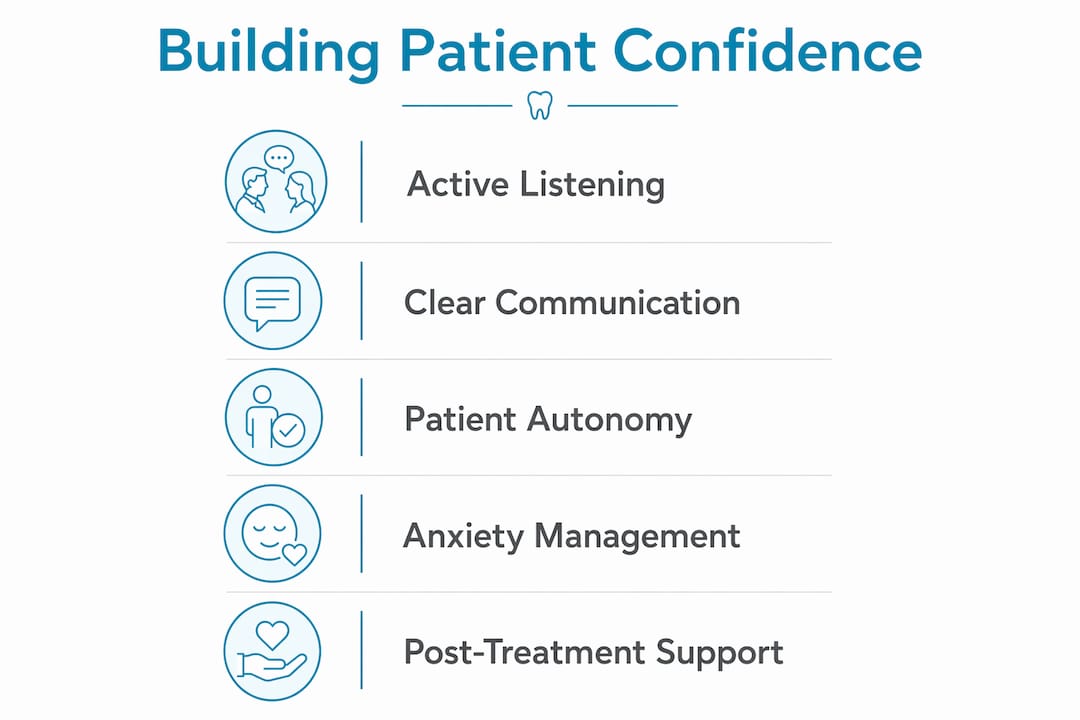
A 2024 multidisciplinary review published in Dentistry Journal outlines a comprehensive communication framework built on respect, active listening, and shared decision-making as the core pillars of patient confidence. The same review identifies cultural sensitivity and follow-up as components that are often underestimated. Many patients in Vaughan and the surrounding communities come from diverse cultural backgrounds, and adjusting communication style to match a patient’s comfort level with directness, detail, or formality makes a real difference.
Visual aids deserve more credit than they typically get. Many patients are surprised to learn how much clearer a procedure becomes when they can see a diagram or an intraoral photo. Showing a patient what a cavity actually looks like on a screen, rather than just describing it, removes the guesswork and reduces anxiety about whether the recommendation is necessary.
Pro Tip: Use the “teach-back” method: after explaining a procedure, ask the patient to describe it back in their own words. This quickly reveals any gaps in understanding and gives you a natural opening to clarify without making the patient feel uninformed.
Practical communication habits that consistently strengthen patient confidence:
- Jargon-free language with simple analogies for clinical terms
- Positive body language: open posture, eye contact, and a calm, steady tone
- Welcoming questions explicitly, not just tolerating them
- Explaining the “why” behind every recommendation, not just the “what”
- Cultural sensitivity in pacing, formality, and level of detail
- Follow-up calls or messages after significant procedures to check on recovery
Patient-centered care: how respecting autonomy builds lasting confidence
Patient-centered care is the recognized standard in modern dentistry, and it goes beyond being friendly. It means treating the patient as the decision-maker in their own care, with the dentist serving as an informed guide rather than an authority who simply prescribes. Research consistently shows that respecting patient autonomy and involving patients in co-creating their treatment plans leads to stronger adherence and greater satisfaction.

In practice, this looks like presenting options rather than directives. When a patient needs a restoration, for example, explaining the differences between materials, timelines, and costs gives them real agency. The right treatment depends on the cause and the patient’s priorities, not just the clinical ideal. That framing shifts the relationship from one-sided to collaborative.
Managing dental anxiety is one of the most important parts of patient-centered care, and it requires personalization. A patient who is anxious about needles needs a different approach than one who is anxious about cost or about past trauma. Research linking person-centered communication to reduced dental anxiety confirms that tailored reassurance, not generic comfort, is what actually helps. For children especially, building trust through gentle pacing and age-appropriate explanations lays the groundwork for a lifetime of positive dental experiences. Regular dental checkups for children are far more likely to happen consistently when kids feel safe in the chair.
Post-treatment support is an underused trust-builder. A follow-up call the day after a root canal or an extraction tells the patient that the relationship doesn’t end when they leave the office. It also catches complications early, which protects both the patient and the practice. Consistent follow-up is one of the clearest signals that a dentist genuinely cares about outcomes, not just procedures.
The clinical environment itself communicates before anyone says a word. A clean, well-lit space with comfortable seating, clear signage, and a calm front desk sets the tone. Patients who feel physically comfortable are more open to conversation and more willing to share concerns they might otherwise keep to themselves.
Core elements of patient-centered dental care:
- Co-creating treatment plans based on patient priorities, not just clinical ideals
- Offering choices wherever clinically appropriate, including material, timing, and phasing
- Pacing appointments to the patient’s comfort level, especially for anxious patients
- Explaining preventive intent clearly, so patients understand why a recommendation is being made
- Post-treatment follow-up as a standard part of care, not an afterthought
- A welcoming physical environment that signals safety and professionalism from the entrance
How Woodbridgedentalcentre approaches patient confidence every day
At Woodbridgedentalcentre, building patient confidence is not a policy. It’s how we practice. Families from Woodbridge, Vaughan, Maple, and the surrounding communities come to us with a wide range of concerns, from routine cleanings to complex restorations, and the approach is the same regardless of the appointment type: listen first, explain clearly, and never rush.
Dr. Michael Rouhi and Dr. Sandra Farber both prioritize time with patients as a non-negotiable part of care. In my experience, the appointments that go smoothest are the ones where the patient felt genuinely heard before the clinical work began. That means asking about concerns at the start of every visit, not just at the first appointment. Patients’ situations change, and so do their anxieties.
Transparency about costs and treatment options is something we take seriously. Many patients are surprised to learn that they can ask for a written treatment plan with costs before committing to anything. We offer that as a standard step, not a special request. That kind of openness addresses one of the most common sources of dental mistrust: the feeling that recommendations are financially motivated rather than clinically necessary. The Canadian Dental Association’s patient communication guidelines support exactly this approach, noting that dentists with fewer patient complaints consistently demonstrate personality-driven communication and spend more time actively listening.
Confidentiality and respectful information handling matter at every level of the practice, not just in the treatment room. Canada’s privacy framework for healthcare sets a clear standard, and our entire team, from the front desk to the hygienists, understands that trust begins at first contact. Every touchpoint, including scheduling, reminders, and follow-up calls, is handled with the same care as the clinical visit itself.
For families with children, we use age-appropriate language, gentle pacing, and a calm environment to make early dental visits positive rather than stressful. The goal is to build a relationship that lasts, not just to complete a cleaning. Patients who feel comfortable as children tend to stay engaged with their oral health as adults, which is the best long-term outcome we can offer. Explore our family dental care services to see how we support patients at every stage of life.
What this looks like at Woodbridgedentalcentre day to day:
- Listening before diagnosing: every appointment starts with an open conversation about how the patient is feeling
- Plain-language treatment explanations with intraoral photos and diagrams when helpful
- Written cost estimates provided before any treatment begins
- Flexible scheduling to reduce the logistical stress that often delays care
- Follow-up calls after significant procedures as a standard part of our process
- A warm, family-friendly environment designed to put patients of all ages at ease
Woodbridgedentalcentre welcomes patients from Woodbridge, Vaughan, Maple, and surrounding communities. If you’ve had a difficult dental experience in the past or simply want a practice where you’ll be heard and treated with honesty, we’d be glad to meet you. Visit our family dental care page to learn more or book an appointment.
Key Takeaways
Dentists build patient confidence most effectively through active listening, transparent communication, and patient-centered care that respects autonomy and addresses anxiety with personalized strategies.
| Point | Details |
|---|---|
| Trust gap is real | Most dentists believe patients trust them fully, but only a small minority of Canadian patients completely agree. |
| Listening outweighs explaining | Listening first to uncover patient fears and goals is more foundational to confidence than clinical explanations alone. |
| Transparency reduces skepticism | Providing written cost estimates and explaining the “why” behind recommendations directly counters mistrust about financial motives. |
| Personalized anxiety care works | Tailored reassurance, not generic comfort, reduces dental anxiety and improves attendance and adherence. |
| Every touchpoint builds trust | Confidence starts at first contact; confidentiality, respectful scheduling, and follow-up calls all reinforce the clinical relationship. |
FAQ
How do dentists build trust with anxious patients?
Dentists build trust with anxious patients by listening to their specific fears before starting any procedure, pacing the appointment to their comfort level, and using person-centered communication that addresses the individual concern rather than offering generic reassurance.
What communication skills matter most for building patient confidence?
Active listening, jargon-free explanations, positive body language, and welcoming questions are the most consistently cited skills in dental communication research. Shared decision-making and cultural sensitivity also play a significant role in how confident patients feel after an appointment.
How do dentists build trust with kids?
Dentists build trust with children through age-appropriate language, gentle pacing, and making early visits feel safe rather than clinical. Consistent positive experiences from a young age are the most reliable way to reduce dental anxiety in adulthood.
Why do some patients distrust their dentist even after years of care?
The most common cause is a perceived gap between what the dentist recommends and what the patient understands about why. When patients feel recommendations may be financially motivated, trust erodes. Transparent cost discussions and clear explanations of preventive intent, as supported by Canadian Dental Association guidance, directly address this concern.
What role does the clinical environment play in patient confidence?
The physical environment signals safety before any conversation begins. A calm, clean, and welcoming space reduces anticipatory anxiety and makes patients more willing to share concerns openly, which in turn allows the dentist to provide more personalized and effective care.


