

Dental veneers are thin, custom-made shells bonded to the front surfaces of your teeth to improve their appearance by correcting discoloration, chips, gaps, and minor misalignment. In clinical terms, they are also called porcelain laminate veneers or composite resin veneers, depending on the material used. Patients across Woodbridge, Vaughan, and Maple ask us about veneers more than almost any other cosmetic treatment. The good news is that dental veneers are one of the most predictable and well-studied cosmetic procedures available, with clear standards for who benefits most and what results to expect. This guide covers everything you need to make an informed decision.
What are the main types of dental veneers?
Porcelain veneers last 10–15 years and resist staining better than any other veneer material. That durability comes from the ceramic structure, which mimics the light-reflecting properties of natural enamel. Porcelain veneers require 2–4 appointments because a dental laboratory fabricates each shell individually after impressions or digital scans are taken.
Composite veneers are made from tooth-colored resin applied directly to the tooth surface. Composite veneers last 5–7 years and can be placed in a single 2–4 hour appointment, making them a practical option for patients who want faster results or a lower upfront cost. They are more prone to staining over time and may need polishing or replacement sooner than porcelain.
| Feature | Porcelain veneers | Composite veneers |
|---|---|---|
| Lifespan | 10–15 years | 5–7 years |
| Appointments needed | 2–4 | 1 |
| Stain resistance | High | Moderate |
| Cost | Higher | Lower |
| Repairability | Difficult | Easier to repair |
| Appearance | Very natural | Good, slightly less translucent |
The right choice depends on your budget, timeline, and how many teeth are involved. Many patients in our Woodbridge practice start with composite veneers on one or two teeth, then upgrade to porcelain when they are ready for a longer-term solution. Both types address the same cosmetic concerns. The difference is durability, appearance quality, and how many visits you need.
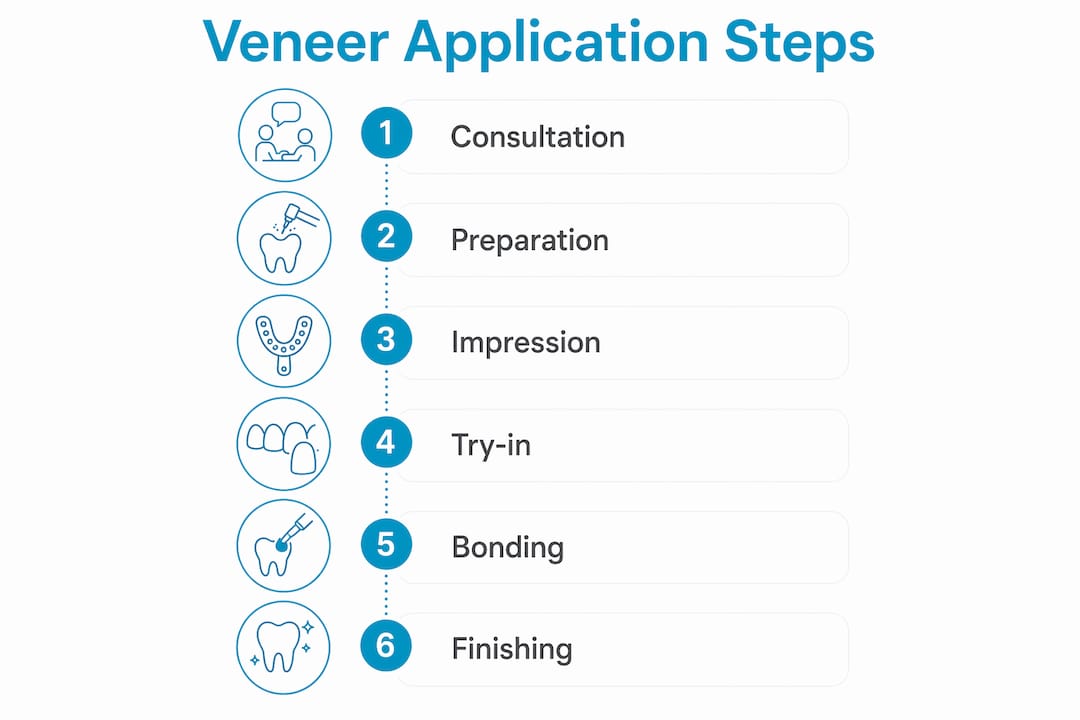
How are dental veneers applied? A step-by-step overview
The dental veneers process follows a clear sequence. Each stage has a specific purpose, and skipping any step increases the risk of a poor outcome.
-
Consultation. Initial consultations assess bite, jaw function, and gum health, not just tooth color or shape. We check for decay, gum disease, and bite problems before discussing aesthetics. This appointment also gives you the chance to share your goals and ask questions. Review our cosmetic dentistry checklist before your visit so you arrive prepared.
-
Preparation appointment. The dentist removes 0.3–0.7 millimeters of enamel from the front of each tooth. This creates space for the veneer to sit flush with neighboring teeth. Impressions or digital scans are taken and sent to the laboratory. Temporary veneers are placed to protect the prepared teeth during the 2–3 week fabrication period.
-
Laboratory fabrication. A dental technician crafts each porcelain shell to match the shade, shape, and size agreed upon during your consultation. This phase takes approximately 2–3 weeks for porcelain veneers.
-
Bonding appointment. The dentist seats each veneer using a try-in gel to confirm shade and fit before any permanent cement is applied. This is your last opportunity to request adjustments. Once you approve the result, the veneer is bonded with permanent resin cement and light-cured into place.
-
Composite single-visit option. For composite veneers, the dentist sculpts the resin directly onto the tooth, shapes it, and polishes it in one appointment. No laboratory phase is needed.
Pro Tip: Take the try-in step seriously. Ask to see your smile in natural light and from different angles before giving final approval. Changes after permanent bonding are not possible without replacing the veneer entirely.
One fact many patients do not expect: veneers involve permanent enamel removal, meaning those teeth will always need a restoration of some kind going forward. The procedure is conservative compared to a dental crown, but it is not reversible. Understanding this upfront helps you commit with confidence rather than hesitation.
Who is a good candidate for dental veneers?
Veneers correct a specific range of cosmetic problems. They work best for patients who have:
- Deep intrinsic discoloration that whitening cannot fix, such as staining from tetracycline or fluorosis
- Chipped or worn tooth edges
- Uneven or irregular tooth shapes
- Small gaps between front teeth
- Mild misalignment that does not require orthodontic correction
Candidates must have healthy teeth and gums with sufficient enamel, and any underlying dental disease must be treated before veneer placement. A patient with active gum disease or untreated decay is not ready for veneers. Treating those conditions first is not a delay. It is the only way to protect your investment.
Veneers are not the right solution for every situation. Patients with severe bite problems, significant tooth grinding (bruxism), large existing fillings, or extensive decay may need crowns or orthodontic treatment instead. Veneers do not move teeth. If your alignment concern is structural, Invisalign in Woodbridge may be a better starting point before any cosmetic work is considered.
A thorough evaluation at Woodbridgedentalcentre looks at the whole picture, not just the teeth you want to change. That approach protects your oral health and gives your veneers the best chance of lasting their full lifespan.
What maintenance do dental veneers require?
Veneers do not eliminate the need for careful oral hygiene. Underlying teeth remain vulnerable to decay even after veneers are placed. The margin where the veneer meets the tooth is the most common site for staining or early decay if cleaning is neglected.
Daily care for veneers includes:
- Brushing twice daily with a non-abrasive fluoride toothpaste
- Flossing every day, paying close attention to the veneer margins
- Attending professional cleanings at least twice a year
- Avoiding biting hard objects like ice, pen caps, or fingernails
- Wearing a night guard if you grind your teeth
Some patients notice tooth sensitivity after veneer placement, particularly to hot and cold. This is normal and typically resolves within a few weeks. If sensitivity persists beyond a month, contact your dentist.
Pro Tip: Watch the veneer margins during your daily brushing routine. Early staining or a slight gap at the edge is a signal to book a check-up before a small issue becomes a larger repair.
Understanding how long cosmetic results last helps you plan realistically. Porcelain veneers maintained with good hygiene and regular check-ups routinely reach their 10–15 year lifespan. Composite veneers need more frequent monitoring and may require polishing or replacement at the 5–7 year mark. For patients who want to maintain brightness between visits, a tooth whitening serum used with a night guard can help keep surrounding teeth matching the veneer shade.
What results can you realistically expect from dental veneers?
Veneers produce a natural-looking result when shade matching and tooth proportions are handled carefully. The most satisfying outcomes come from patients who communicate clearly with their dental team about what they want and what they want to avoid.
Veneers address cosmetic concerns that other treatments cannot. Teeth whitening does not correct intrinsic discoloration from medications or developmental issues. Bonding can chip more easily than porcelain. Veneers fill that gap for patients who want a durable, natural-looking correction.
Veneers also provide protective benefits beyond aesthetics, reinforcing weakened enamel and improving bite efficiency. Many patients are genuinely surprised to learn their veneers serve a restorative function alongside the cosmetic one. That dual benefit makes them worth considering for teeth with worn or thinned enamel, not just discolored ones.
Veneers do not fix severe malocclusion, jaw problems, or missing teeth. They are a cosmetic and mildly restorative tool. Patients who approach them with that understanding tend to be the most satisfied. Explore the full range of cosmetic dentistry options to see where veneers fit within a broader smile plan.
Key Takeaways
Dental veneers are a durable, clinically proven cosmetic treatment that requires healthy teeth, sufficient enamel, and a long-term commitment to oral hygiene to deliver lasting results.
| Point | Details |
|---|---|
| Two primary types | Porcelain veneers last 10–15 years; composite veneers last 5–7 years and require only one visit. |
| Irreversible procedure | Enamel removal is permanent, so patients will always need a restoration on prepared teeth. |
| Health prerequisites | Active decay or gum disease must be treated before veneer placement can begin. |
| Hygiene is critical | Veneer margins are vulnerable to staining and decay without daily flossing and regular cleanings. |
| Dual function | Veneers improve appearance and can reinforce weakened enamel, offering both cosmetic and protective benefits. |
What 25 years of veneer cases taught me
The patients who get the most from their veneers are the ones who come in with realistic expectations and a willingness to talk honestly about their goals. In my experience, the consultation appointment matters more than any other step in the process. That is where we figure out whether veneers are actually the right solution, or whether whitening, bonding, or orthodontics would serve you better.
Many patients arrive thinking veneers are a quick cosmetic fix. What they often miss is the long-term commitment involved. You are permanently altering the enamel on those teeth. That is not a reason to avoid veneers. It is a reason to choose them thoughtfully, with a dental team you trust.
The cases I have seen fail almost always share one cause: neglected oral hygiene after placement. Patients invest in beautiful veneers and then stop flossing consistently. The margins deteriorate, decay develops underneath, and the veneer has to be replaced years earlier than it should. The veneer itself is not the problem. The care around it is.
My honest advice is this: treat your veneers like the long-term investment they are. Keep your check-up appointments, maintain your hygiene routine, and tell your dentist immediately if something feels different. A small issue caught early is almost always a simple fix. The same issue ignored for a year rarely is.
For families in Woodbridge and Vaughan considering veneers, the most important first step is a thorough evaluation, not a quote. Understanding your oral health baseline is what makes every cosmetic decision that follows a confident one.
— Felix
Smile planning at Woodbridgedentalcentre

Woodbridgedentalcentre serves patients across Woodbridge, Vaughan, and Maple who are considering veneers and want honest, experienced guidance before committing to treatment. Dr. Michael Rouhi, Dr. Sandra Farber, and the team take time at every consultation to evaluate your full oral health picture, explain your options clearly, and build a plan that fits your goals and your life. Whether you are ready to move forward or still weighing your options, a conversation with our team costs you nothing and gives you real clarity. Visit our cosmetic dentistry page to learn more about the services we offer, or book a consultation to get a personalized assessment from a team that has been caring for local families for years.
FAQ
What are dental veneers made of?
Dental veneers are made from either porcelain ceramic or composite resin. Porcelain veneers are fabricated in a dental laboratory, while composite veneers are applied and shaped directly on the tooth in a single visit.
Are dental veneers permanent?
Yes. Veneer placement requires removing 0.3–0.7 mm of enamel, which does not grow back. Once prepared, those teeth will always need a veneer or similar restoration.
How long do dental veneers last?
Porcelain veneers typically last 10–15 years with proper care. Composite veneers last 5–7 years and may need polishing or replacement sooner.
Do dental veneers hurt?
Most patients experience little to no discomfort during placement. Some sensitivity to hot and cold is normal after the procedure and usually resolves within a few weeks.
Can veneers fix crooked teeth?
Veneers can improve the appearance of mildly misaligned teeth, but they do not move teeth. Significant alignment issues require orthodontic treatment such as Invisalign before or instead of veneers.


