

During a children’s dental checkup, a dentist examines far more than just teeth; for insights you might find helpful, see these top strategies for healthy dental care for kids in Western Sydney. From the moment your child sits down, we are assessing jaw development, oral habits, early signs of decay, gum health, and risk factors that could affect their smile for years to come. Understanding what happens during a pediatric dental exam helps you walk in prepared and walk out confident.
Here is a quick overview of what a dentist looks for during a child’s visit:
- Extra-oral exam: shape and symmetry of the face, jaw growth, and bite alignment
- Intra-oral exam: condition of teeth, gums, tongue, and soft tissues
- Early childhood tooth decay (ECTD): white, chalky, or brown spots near the gumline
- Oral habits: thumb-sucking, pacifier use, or mouth breathing that may affect tooth position
- Jaw and bite development: spacing, crowding, and early signs of malocclusion
- Diet and feeding practices: frequency of sugary drinks, bottle use at bedtime
- Caries risk assessment: biological, protective, and clinical factors combined
- Fluoride exposure and home hygiene: brushing technique, toothpaste type, and routine
## 1. What does a dentist actually examine during a pediatric dental visit?
A pediatric dental exam follows a clear, two-part structure: extra-oral first, then intra-oral. The extra-oral portion means we look at your child’s face, head, and neck before ever opening their mouth. We are checking for facial symmetry, jaw alignment, and any swelling or asymmetry that might signal a developing problem. This takes less than a minute but gives us useful context.
The intra-oral exam covers teeth, gums, tongue, cheeks, and the roof of the mouth. We check each tooth surface for signs of decay, enamel defects, and discoloration. Gum tissue is assessed for redness or swelling, which can appear even in toddlers with poor oral hygiene habits.
| Exam Component | What We Assess | Why It Matters |
|---|---|---|
| Extra-oral exam | Face, jaw, lymph nodes | Detects growth issues early |
| Tooth surfaces | Decay, enamel defects, staining | Identifies ECTD and cavity risk |
| Gum tissue | Redness, swelling, bleeding | Flags early gum disease |
| Bite and occlusion | Spacing, crowding, crossbite | Guides orthodontic planning |
| Oral habits | Thumb-sucking, pacifier, mouth breathing | Assesses impact on tooth position |
| Diet and hygiene review | Sugar frequency, brushing routine | Shapes prevention recommendations |
Beyond the physical exam, we ask about diet, feeding habits, and home hygiene. Caries risk assessment includes biological factors like a parent’s active cavities, how often your child consumes sugar, fluoride exposure, and socioeconomic considerations. All of this shapes the prevention plan we build with you.
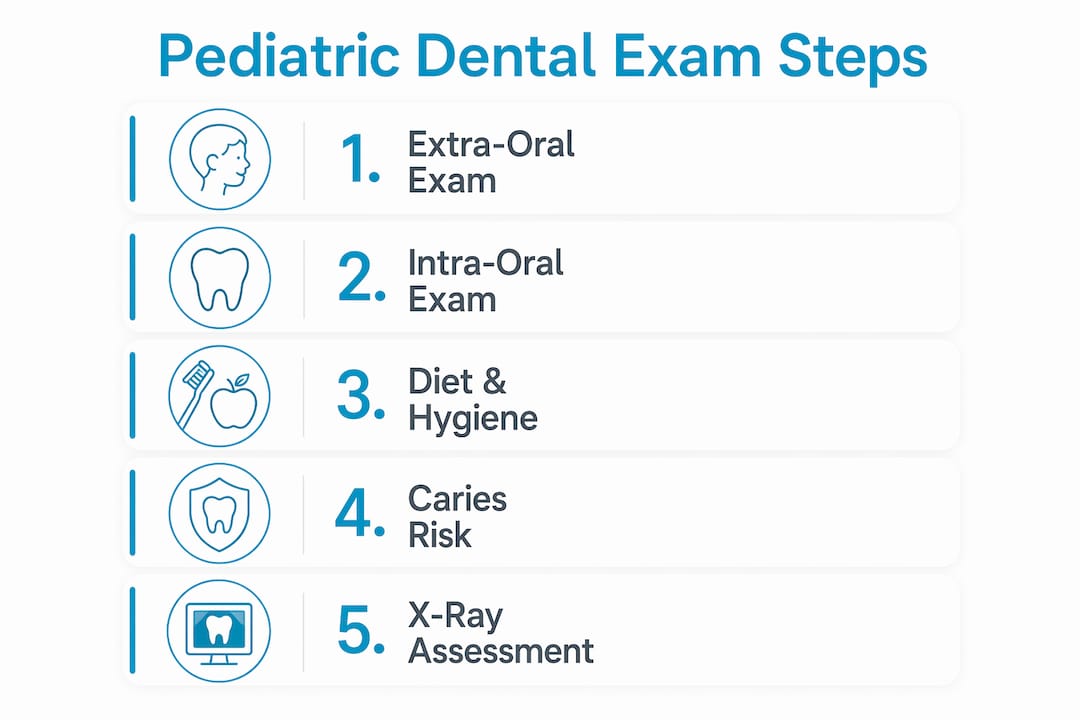
X-rays are not routine at every visit. For young children, we recommend them only when clinical signs suggest a problem that cannot be seen with the naked eye, or when a child reaches an age where decay between teeth becomes more likely. Dental impressions are rarely needed at early visits but may be used later if orthodontic concerns arise.
## 2. How parents can prepare their child for a dental visit
The single most effective thing you can do is schedule the appointment at the right time of day. A well-rested, recently fed child cooperates far better than a tired or hungry one. Scheduling around your child’s best energy window is a simple step that makes a real difference in how the visit goes.
Before the appointment, explain what will happen in simple, honest terms. Avoid words like “hurt,” “needle,” or “drill.” Instead, describe the dentist as someone who counts teeth and checks that they are growing well. Children pick up on parental anxiety, so staying calm yourself is genuinely helpful.
- Bring a comfort item, a small toy or a favorite stuffed animal, to give your child something familiar to hold.
- Let your child sit in your lap during the exam if they are very young. For infants and toddlers, the knee-to-knee exam positions the child facing you while the dentist examines from the other side, which keeps the child calm and gives us full access.
- Avoid bribing with sweets after the visit. Positive reinforcement works better: praise the specific behavior (“You opened your mouth so well”) rather than the outcome.
- Never tell a child the dentist will not hurt them. That promise can backfire. Instead, say the dentist will be gentle and you will be right there.
Pro Tip: Practice “opening wide” at home a few days before the visit. Make it a game. Children who have done this once or twice are noticeably more relaxed when the dentist asks them to do the same thing.

## 3. What to expect at your child’s first and follow-up dental visits
The first dental visit is often shorter than parents expect. The hands-on exam with a toddler typically lasts only a few minutes. Most of the appointment is spent talking with you about home hygiene, diet, fluoride, and what to watch for between visits. That conversation is not filler. Parental education at early visits has a lasting impact on a child’s oral health trajectory.
Here is what typically happens across visits:
- First visit (around age 1): Brief exam, gum and tooth assessment, parent counseling on brushing and diet, fluoride varnish if recommended
- Follow-up visits (every 6 months or as advised): Cleaning, updated exam, X-rays if indicated, reassessment of habits and growth
- Higher-risk children: May be seen more frequently, with fluoride varnish applied at each visit
Fluoride varnish is a tinted liquid applied directly to tooth surfaces. It releases fluoride over time, strengthening enamel and reducing decay risk. Canada’s public health guidelines recommend discussing fluoride varnish with your oral health professional early in your child’s dental care. Dental sealants become relevant once permanent molars erupt, typically around age six.
Signs that warrant an earlier or unscheduled visit include visible white or brown spots on teeth, a tooth that has been knocked or chipped, complaints of tooth pain, or any swelling in the gums or jaw. Do not wait for the next scheduled checkup if you notice any of these.
## 4. Pediatric dental health in Canada: what the numbers tell us
The prevalence of tooth decay among Canadian children aged 6–11 is striking: 57% have at least one affected tooth, a figure that has remained stable since 2007–2009. A separate measurement from 2022–2024 found that 17% of children aged 1–5 already had at least one primary tooth affected by decay, the first time this age group was formally tracked.
The Canadian Dental Association recommends the first dental assessment within six months of the first tooth erupting, or by the child’s first birthday at the latest. Many families in Woodbridge, Vaughan, and Maple wait until age three or four, which means early decay can go undetected for years.
Risk factors that dentists in our region commonly identify include:
- Frequent consumption of juice, sweetened beverages, or milk at bedtime
- Enamel hypoplasia, a developmental defect that makes teeth more vulnerable to decay
- Low fluoride exposure, particularly in children not using fluoridated toothpaste
- A parent with active, untreated cavities, which increases bacterial transmission to the child
- Infrequent or no dental visits before age three
At Woodbridgedentalcentre, our approach to children’s dental care is built around prevention and long-term monitoring. We track jaw growth, eruption patterns, and habit-related changes across visits so that nothing develops quietly between appointments. For families concerned about nutrition’s role in oral health, we address diet directly during the exam, not as an afterthought.
If your child is due for a checkup or has never seen a dentist, our team at Woodbridgedentalcentre is here to help. 
Book a family dental visit with us in Woodbridge. We see children of all ages, from first teeth through the teenage years, in a calm, welcoming environment where your child’s comfort comes first.
Key Takeaways
Pediatric dental exams assess jaw development, oral habits, decay risk, and hygiene practices, making early and regular visits the most effective tool for protecting a child’s long-term oral health.
| Point | Details |
|---|---|
| First visit timing | The Canadian Dental Association recommends the first visit within 6 months of the first tooth or by age 1. |
| Decay prevalence | 57% of Canadian children aged 6–11 have at least one tooth affected by decay. |
| Exam structure | Dentists assess face, jaw, teeth, gums, oral habits, diet, and caries risk at every visit. |
| Parental role | Much of the early visit focuses on counseling parents, not just examining the child. |
| Early warning signs | White or brown spots near the gumline, tooth pain, or swelling warrant an immediate visit. |
FAQ
What are common dental problems found in children?
Tooth decay (dental caries) is the most common, affecting more than half of Canadian children aged 6–11. Other frequent findings include enamel defects, gum inflammation, bite issues, and problems caused by prolonged thumb-sucking or pacifier use.
What should I expect at my child’s first dentist appointment?
The hands-on exam typically lasts about five minutes for toddlers, with most of the visit focused on parent education about brushing, diet, and fluoride. The dentist will check teeth, gums, and jaw development, and may apply fluoride varnish.
What is the rule of 7 in pediatric dentistry?
The rule of 7 is a general guideline suggesting that children should have their first orthodontic evaluation when enough permanent teeth have erupted to assess bite development and spacing concerns. Definitions vary slightly by provider, but early school-age is the widely cited benchmark.
What should I look for in a pediatric dentist?
Look for a dentist experienced with young children who explains findings clearly to parents, uses a calm and gentle approach, and follows Canadian Dental Association guidelines on preventive care and visit timing. A practice that offers family dental services under one roof also makes scheduling easier as your child grows.
Recommended
- How to Find the Best Kids Dentist Near You | Parent’s Guide to Pediatric Dental Clinics – Woodbridge Dental Centre | Cosmetic, Implant & Family Dentistry
- What Is a Kid-Friendly Dental Office? A Parent’s Guide
- How to Choose a Pediatric Dentist | 7 Questions to Ask Before You Book – Woodbridge Dental Centre | Cosmetic, Implant & Family Dentistry
- What to Expect from a Pediatric Dental Cleaning | A Step-by-Step Look Inside – Woodbridge Dental Centre | Cosmetic, Implant & Family Dentistry


