

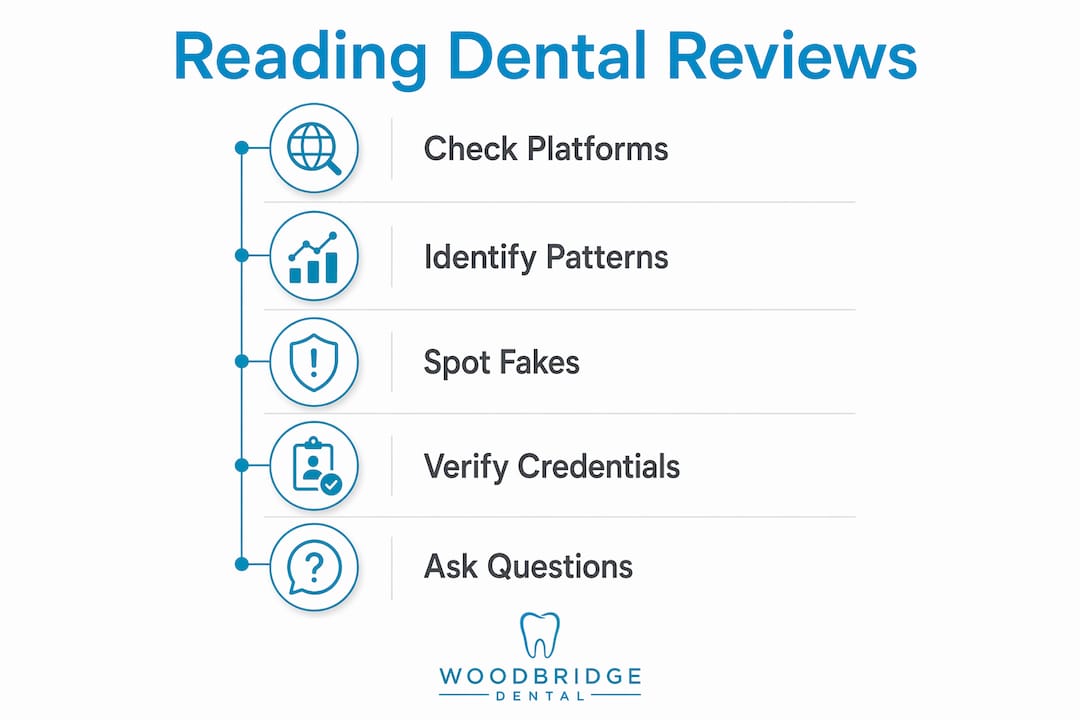
Treat reviews as signals, not verdicts. The most reliable approach to reading dental clinic reviews effectively is to scan at least three independent platforms for recurring themes, verify the dentist’s license with your provincial dental college, and use what you find to form two or three specific questions before you book. A single glowing review tells you almost nothing. A pattern of the same praise or the same complaint across Google Reviews, RateMDs, and Facebook Reviews tells you quite a lot.
Here is a practical three-step starting point:
- Step 1: Open Google Reviews, RateMDs, and Facebook Reviews for the clinic. Filter by most recent and read the 3-star and 4-star reviews first. Note any theme that appears more than twice.
- Step 2: Look up the dentist by name on your provincial dental regulatory body. In Ontario, that is the Royal College of Dental Surgeons of Ontario (RCDSO). Confirm the license is active and check for any disciplinary history.
- Step 3: Write down two or three questions based on what you read. If three reviewers mentioned long wait times, ask the clinic directly about their average appointment wait.
Pro Tip: Research suggests a significant portion of online reviews across industries may be fake or manipulated. That number alone is reason enough to cross-check platforms and verify credentials independently before trusting any single rating.
What should you actually look for in dental reviews?
Not every review deserves equal weight. Learning to separate the useful from the noise is the real skill when analyzing dental practice reviews.
Green flags worth noting:
- The reviewer names a specific procedure (crown, root canal, cleaning) and describes how it felt
- Multiple reviewers across different platforms praise the same thing: clear explanations, gentle technique, or honest pricing
- The clinic responds to negative reviews promptly and offers to follow up offline
- Reviews span several years with consistent quality, not a sudden burst of five-star ratings
Red flags that warrant real concern:
- Repeated reports of clinical harm: unexpected pain, complications, or missed follow-up after treatment
- Multiple reviewers mention the same hygiene or safety concern
- Clusters of reviews posted within days of each other, all using similar language
- Consistent complaints about billing errors or pressure to accept unnecessary treatment
The distinction between clinical and operational complaints matters. A reviewer frustrated by a busy phone line or a parking shortage is describing an administrative inconvenience, not a clinical risk. Administrative frustrations such as billing confusion or poor phone etiquette reflect operational gaps, not the dentist’s skill. Weight clinical concerns more heavily. Operational issues are worth noting, but they rarely mean you should walk away.
Many patients are surprised to learn that 3-star and 4-star reviews often contain the most useful detail. A reviewer who gives four stars usually explains why: good care, but the wait was long, or the dentist was thorough, but the front desk was hard to reach. That kind of trade-off is exactly what you need to know before booking.

Where do you find reliable dental reviews in Canada?
Each platform has its own strengths and blind spots. Checking just one gives you a partial picture.
| Platform | Strengths | Limitations |
|---|---|---|
| Google Reviews | High volume, easy to find, shows recent activity | Algorithmic filtering can hide some reviews |
| RateMDs | Healthcare-focused reviewer base, condition-specific | Lower total volume for some clinics |
| Yelp Canada | Consumer-driven, often detailed | Mixed verification; some reviews filtered without explanation |
| Facebook Reviews | Reviewers often identifiable by profile | Easier for clinic to manage or remove |
| Clinic website | Convenient, often includes photos | Practice websites tend to show higher scores and lower reviewer identifiability |
A British Dental Journal analysis found that practice websites had a mean score of 4.94/5, noticeably higher than Google, Facebook, or NHS listings, and that reviewer identifiability was lower on clinic sites than on Google or Facebook. That gap is worth keeping in mind when a clinic’s own testimonial page looks uniformly glowing.
The good news is that checking multiple independent platforms gives you a more balanced reputation signal. When Google, RateMDs, and Facebook all point to the same strength or the same concern, that pattern is meaningful.
For Woodbridge, Vaughan, and Maple families specifically: review volumes at local clinics can be lower than at downtown Toronto practices, so a clinic with 40 reviews may still give you a reliable picture if the feedback is detailed and spans at least two years. Common local themes include parking access, bilingual service (Italian, Persian, and other languages are frequently mentioned in Vaughan-area reviews), and appointment wait times, which are worth asking about directly.
Pro Tip: When you open a reviewer’s profile on Google or Facebook, check how many reviews they have written. A profile with only one review, posted the same week as several others at the same clinic, is a common sign of a manufactured review.
How do you spot fake or paid dental reviews?
Fake reviews exist in every industry, and dental listings are not immune. Here is a practical checklist to apply before you trust a rating.
Signs a review may not be genuine:
- Posted within a short window alongside several other five-star reviews (a timing cluster)
- Uses identical or near-identical phrasing to other reviews at the same clinic
- Reviewer profile has only one review, no photo, and a generic name
- Language is vague or overly emotional with no procedural detail (“Amazing experience, best dentist ever!”)
- No mention of a specific treatment, staff member, or visit date
Two manipulation patterns to know:
- Fake-positive campaigns: Some clinics use review farms or ask staff and family members to post five-star ratings. The result is a sudden jump in score with no corresponding change in service.
- Fake-negative attacks: A competitor or a disgruntled former patient may post one-sided negative reviews. If a clinic has 80 detailed positive reviews and two extreme one-star reviews with no specifics, the outliers deserve less weight.
When you see three or more suspicious signals together across a platform, that is worth flagging. Cross-check on a second platform. If the pattern holds, treat the rating as unreliable and rely instead on verified licensure and a direct conversation with the clinic.
What do clinic responses to reviews tell you?
How a clinic responds to feedback is one of the most underused signals available to patients. A thoughtful public response is a reliable indicator of accountability and willingness to address gaps.
Signs of a response that builds trust:
- Posted within a few days of the review
- Acknowledges the specific concern without being defensive
- Offers to continue the conversation privately (“Please call us so we can make this right”)
- Describes a corrective step when the complaint is operational (“We’ve updated our scheduling system”)
Signs of a response that raises questions:
- Generic “Thank you for your feedback!” on every five-star review, with nothing more
- A public argument with the reviewer, especially one that questions the reviewer’s honesty
- Silence on clinical complaints while responding warmly to praise
- No offer to follow up on a concern about treatment outcomes
One practical example: a reviewer notes that their post-extraction follow-up call never came. A good response acknowledges the gap, apologizes, and explains the new protocol. A poor response says nothing, or worse, implies the patient is mistaken. The response does not erase the concern, but it tells you whether the clinic takes accountability seriously. Pair this signal with licensing verification and cross-platform patterns, and you have a much clearer picture. Understanding how dentists build patient confidence through communication is part of what separates a trustworthy practice from one that just looks good on paper.

How do you verify a dentist’s credentials in Canada?
Reviews tell you about patient experience. They cannot tell you whether a dentist is licensed, in good standing, or has a disciplinary history. That information lives with your provincial dental college, and checking it takes about two minutes.
Step-by-step verification:
- Identify your province’s dental regulatory body. In Ontario: the RCDSO. In British Columbia: the College of Dental Surgeons of BC. In Alberta: the Alberta Dental Association and College.
- Use the public registry search to look up the dentist by name.
- Confirm the license is current and in good standing.
- Check for any conditions on the license or disciplinary findings. These are public record.
- If a review mentions a clinical concern, compare it against the disciplinary record before deciding whether to book.
This step is non-negotiable. Provincial dental college registries provide license status and disciplinary history that no review platform can replicate. A dentist with a clean record and a 4.2-star rating is often a safer choice than one with a 4.9 and no verifiable credentials.
Statistic to keep in mind: Research indicates that up to 30% of online reviews across industries may be fake or manipulated. For patients, that means a star rating alone is never sufficient. The college registry is the one source that cannot be gamed.
Pro Tip: If a review describes a serious clinical harm (nerve damage, a missed diagnosis, an infection after a procedure), do not rely on the clinic’s response alone. Check the RCDSO or your provincial equivalent for any related findings, then call the clinic to ask for a consultation before committing to treatment.
Questions to ask the clinic after reading reviews
Reviews give you the raw material. These questions let you verify what you found and fill in the gaps. Use them when you call or during a first consultation. For parents researching pediatric dental care, the children’s section below is especially relevant.
Clinical care:
- What sedation or comfort options do you offer for anxious patients?
- If I have a complication after treatment, how do I reach someone after hours?
- How do you follow up with patients after major procedures?
Logistics and access:
- What is the typical wait time for a new patient appointment?
- Do you offer early morning, evening, or weekend appointments?
- Which languages does your team speak?
Financial:
- Do you provide written estimates before treatment begins?
- Which insurance plans do you accept, and do you direct-bill?
- What is your payment policy for larger treatments?
Comfort and fit:
- Do you have experience treating children or patients with dental anxiety?
- Can I request a consultation before committing to a treatment plan?
- How do you handle patients who need accommodations or have accessibility needs?
Any clinic that hesitates on the written estimate question or cannot explain its after-hours protocol deserves a follow-up conversation before you book. Answers to the financial questions in particular are deal-breakers for many families. You can also review dental appointment preparation tips to arrive at your first visit ready to ask the right things.
Key Takeaways
Reading dental clinic reviews effectively means treating patterns as evidence and using what you find to verify and question, not just to decide.
| Point | Details |
|---|---|
| Cross-platform patterns matter most | Check Google Reviews, RateMDs, and Facebook Reviews together; one platform alone is not enough. |
| Middle-range reviews carry the most detail | 3-star and 4-star reviews typically include specific trade-offs that help you assess real day-to-day experience. |
| Verify licensure independently | Look up every dentist on your provincial college registry (e.g., RCDSO) to confirm license status and disciplinary history. |
| Clinic responses reveal practice culture | A specific, accountable reply to a complaint tells you more than the complaint itself. |
| Woodbridgedentalcentre supports transparency | Dr. Michael Rouhi and Dr. Sandra Farber welcome questions from reviews and offer consultations so patients can verify fit before committing. |
A local dentist’s perspective on reading reviews
In my experience, the patients who arrive most prepared are the ones who read reviews as a starting point rather than a final answer. They come in with two or three specific questions, and those conversations are always more productive than a first visit where someone is still deciding whether to trust us.
Many patients in Woodbridge and Vaughan tell me they felt reassured by our reviews, but what actually settled their decision was calling ahead and asking about sedation options or whether we see children. That direct contact is what reviews are supposed to prompt. When a family from Maple reads that our team is patient with anxious kids, I want them to call and confirm that for themselves, not just take a stranger’s word for it.
The misunderstanding I see most often is patients dismissing a clinic over one negative review, or choosing one based on a perfect score with no detail. Both are mistakes. A 4.3 with 90 honest reviews is almost always more informative than a 5.0 with 12. Local clinics in high-demand areas like Vaughan also tend to get more access-related complaints (parking, wait times, phone volume) simply because demand is high. Those complaints are worth noting, but they rarely reflect the quality of care you will receive chairside.
What truly matters in that first visit is whether the dentist listens, explains the treatment clearly, and gives you a written estimate before anything begins. Reviews can point you toward that kind of practice. They cannot replace the conversation.
Woodbridgedentalcentre: a trusted local option for Vaughan families
Families across Woodbridge, Vaughan, and Maple who want a clinic where the answers to those review-prompted questions are easy to get will find that at Woodbridgedentalcentre. Dr. Michael Rouhi and Dr. Sandra Farber lead a team that provides written treatment estimates, clear explanations before any procedure, and direct after-hours contact for urgent concerns.
The clinic offers family dental care for patients of all ages, from children’s first visits to restorative and cosmetic treatments for adults. Transparent pricing, direct insurance billing, and a welcoming environment for anxious patients are among the things local families mention most in their own reviews; learn more about their pricing and payment options. If you have questions formed from reading reviews elsewhere, bring them to a consultation. The team is used to that conversation and welcomes it. Call Woodbridgedentalcentre or book online to get started.
Useful sources
These are the primary Canadian and peer-reviewed sources to use when verifying dentist credentials or learning more about review reliability.
| Source | What it verifies | When to use it |
|---|---|---|
| RCDSO (Royal College of Dental Surgeons of Ontario) | License status, conditions, disciplinary history for Ontario dentists | Before booking any Ontario dental clinic |
| College of Dental Surgeons of BC | License and discipline records for BC dentists | For patients in British Columbia |
| Canada Dental Advisor | Practical guidance on choosing a dentist in Canada | General research and verification steps |
| British Dental Journal (BDJ Open) | Peer-reviewed analysis of review platform differences and score inflation | Understanding why clinic website scores differ from Google |
| Careviv | Canada-specific guidance on using reviews alongside official registries | Cross-platform review strategy and red-flag identification |
FAQ
How do you check reviews on a dentist?
Search the dentist’s name or clinic on Google Reviews, RateMDs, and Facebook Reviews, then filter by most recent. Read the 3-star and 4-star reviews for specific detail, and always verify the dentist’s license on your provincial dental college registry (such as the RCDSO in Ontario).
What makes a dental review actually useful?
A useful review names a specific procedure, describes how the dentist communicated, and mentions at least one concrete detail such as wait time, pain management, or follow-up care. Vague one-line praise or one-line complaints without context tell you very little.
How can you tell if a dental review is fake?
Look for timing clusters (several five-star reviews posted within days of each other), reviewer profiles with only one review and no photo, and language that is identical or nearly identical across multiple reviews. When three or more of these signals appear together, treat the rating with caution and cross-check on a second platform.
Should you trust a dentist’s website testimonials?
Treat them as a starting point only. Research published in the British Dental Journal found that practice websites tend to show higher average scores and lower reviewer identifiability than Google or Facebook, which suggests clinic-curated testimonials may not reflect the full range of patient experience.
What questions should you ask a dental clinic after reading reviews?
Ask about sedation options, after-hours contact for complications, written estimates before treatment, insurance billing, and languages spoken by the team. These questions convert review patterns into direct, verifiable answers before you commit to care.


