

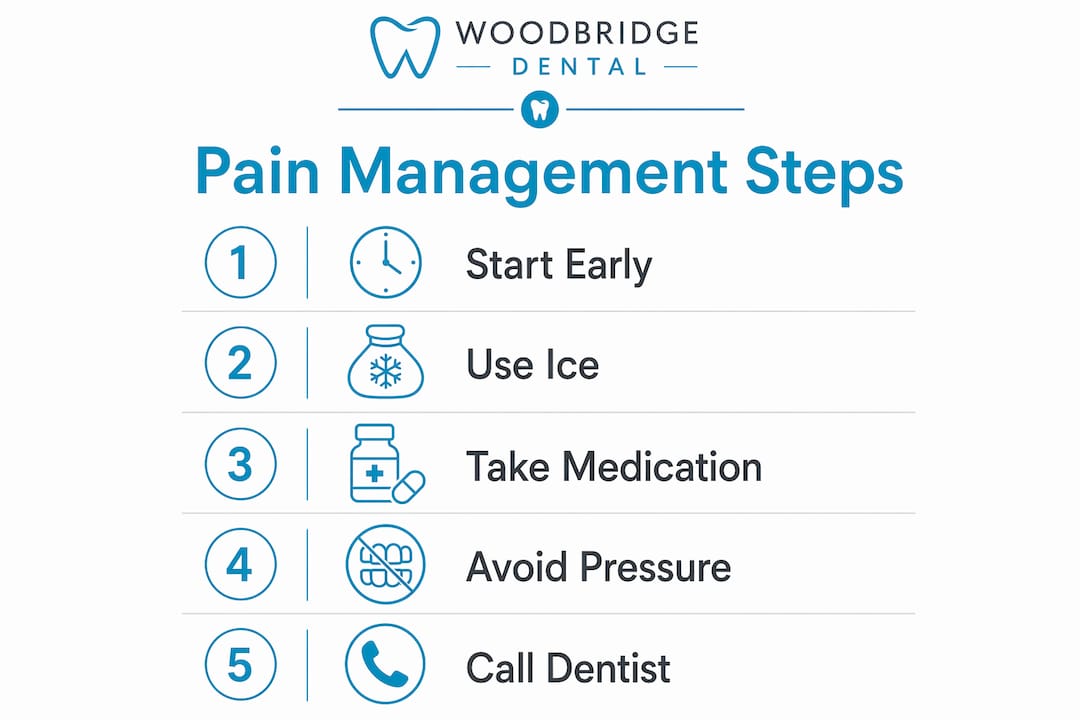
Some soreness after a filling, crown, or other restorative dental work is completely normal. The good news is that most patients can manage pain after restorative dental work effectively at home with cold packs, careful eating, and the right over-the-counter medication. Take ibuprofen or acetaminophen as directed, apply a cold pack to your cheek for the first 24 hours, and avoid chewing on the treated side. Call your dentist if any of the red flags below appear.
First 24-hour action checklist:
- Apply a cold pack (wrapped in a cloth) to the outside of your cheek for 15–20 minutes at a time during the first 24 hours.
- Take ibuprofen (400–600 mg) or acetaminophen (500–1,000 mg) with food before the anesthetic fully wears off, if your health allows.
- Eat soft foods only: yogurt, mashed potatoes, scrambled eggs, soup.
- Avoid chewing on the treated side until soreness settles.
- Rinse gently with warm salt water (half a teaspoon of salt in a glass of warm water) starting 24 hours after the procedure.
- Keep your head elevated, especially when sleeping, to reduce throbbing.
- Avoid alcohol, very hot drinks, and straws for the first 48 hours.
Call your dentist or seek emergency care immediately if you notice:
- Swelling that is spreading toward your eye, neck, or throat, or that makes it hard to breathe or swallow.
- Uncontrolled bleeding that does not stop with gentle pressure.
- Fever above 38°C (100.4°F).
- Pain that is getting worse after the first 48–72 hours, not better.
- Signs of an allergic reaction: hives, facial swelling, or difficulty breathing after taking medication.
The Canadian Dental Association (CDA) and the Royal College of Dental Surgeons of Ontario (RCDSO) both emphasize that treating the source of pain through dental intervention is the primary goal. Medication manages symptoms while your dentist addresses the underlying cause.
What sensations are normal vs. abnormal after a filling or crown?
Understanding what your body is telling you makes a real difference in how you respond to post-treatment discomfort.
Normal sensations and their typical timeline:
- Mild aching or soreness at the gum line or around the tooth: common for 24–72 hours.
- Temperature sensitivity (cold more than hot): very common after fillings and crowns; usually fades within one to two weeks.
- Temporary numbness or tingling in the lip, tongue, or cheek: normal while the local anesthetic wears off, typically two to four hours.
- Mild pressure or tenderness when biting: often peaks in the first 48 hours and gradually improves.
Post-operative pain typically peaks within the first 2–3 days and then steadily declines. If you had a more involved procedure, such as a crown preparation or a deep filling close to the nerve, sensitivity can linger for a few weeks as the tooth settles.
Symptoms that are not normal and need attention:
- Sharp, spontaneous pain that wakes you at night.
- Pain that is constant, deep, and throbbing rather than occasional and mild.
- Sensitivity that is getting worse after the first few days, not better.
- Visible swelling, pus, or a bad taste in your mouth.
- Sensitivity that persists beyond two to three weeks without any improvement.
Many patients are surprised to learn that persistent sensitivity beyond a few weeks may indicate irreversible pulpitis, a condition where the nerve inside the tooth is inflamed beyond its ability to recover. That is not a dental emergency in most cases, but it does need professional assessment.
A useful benchmark: If your pain is improving day by day, you are almost certainly on the right track. If it is holding steady or worsening after 72 hours, contact your dental office.
Step-by-step at-home care for the first 72 hours
The first three days after a restoration set the tone for your recovery. These steps are listed in the order you should follow them.
-
Take your first dose of pain medication before the freezing wears off. Starting an NSAID like ibuprofen while the anesthetic is still active can blunt the development of the pain cycle and reduce peak discomfort, according to evidence on preoperative NSAID dosing. Do not wait until the pain is severe.
-
Apply a cold pack to your cheek for the first 24 hours. Use a cloth-wrapped ice pack or a bag of frozen peas. Apply for 15–20 minutes, then remove for 20 minutes. Cold reduces swelling and numbs the area. After 48 hours, switch to a warm compress if the area still aches.
-
Eat soft, room-temperature foods. Avoid anything hard, crunchy, sticky, or very hot or cold. Good choices: soft-cooked pasta, bananas, oatmeal, avocado, and well-cooked vegetables. Chew on the opposite side of your mouth.
-
Start gentle saltwater rinses after 24 hours. Mix half a teaspoon of table salt into a glass of warm water. Swish gently for 30 seconds and spit. Do this two to three times a day. Saltwater reduces bacteria around the healing tissue without irritating it.
-
Brush and floss gently around the treated area. Use a soft-bristled toothbrush and light pressure. Do not skip oral hygiene; bacteria near a new restoration can cause problems. Floss carefully, sliding the floss out sideways rather than snapping it up through the contact.
-
Avoid straws for the first 48 hours if your procedure involved any tissue work or extraction near the restoration. Suction can dislodge healing tissue and slow recovery.
-
Keep your head elevated when resting. Lying flat increases blood pressure to the head and can intensify throbbing. Prop yourself up with an extra pillow, even while watching TV.
Pro Tip: Sleep on the opposite side from the treated tooth. Placing a thin pillow between your cheek and the mattress reduces direct pressure on the jaw and often makes a noticeable difference in how you feel the next morning.

Which medications work best for dental pain after a restoration?
The right medication choice depends on your health history, but for most adults, acetaminophen and NSAIDs are the first-line options recommended by Canadian dental guidelines.

Acetaminophen vs. NSAIDs: which to choose
Acetaminophen (Tylenol) is first-line for mild-to-moderate pain, particularly if you cannot take anti-inflammatory drugs. NSAIDs like ibuprofen (Advil, Motrin) or naproxen (Aleve) reduce both pain and inflammation, making them especially useful in the first 48 hours when swelling is a factor. Systematic evidence supports alternating acetaminophen and an NSAID for better control of moderate-to-severe dental pain than either medication alone, in patients whose health allows it.
Adult dosing reference
| Medication | Standard adult dose | Maximum daily dose | Key notes |
|---|---|---|---|
| Acetaminophen | 500–1,000 mg every 4–6 hours | 4,000 mg | Do not combine with alcohol |
| Ibuprofen | 400–600 mg every 6–8 hours | — | Take with food; avoid with kidney disease or anticoagulants |
| Naproxen sodium | 200 mg every 6–8 hours | 600 mg (OTC) | Longer-acting; useful for overnight coverage |
Pediatric dosing is always weight-based. Ask your dentist or pharmacist for the correct dose for your child’s weight before giving any pain medication.
Alternating strategy for moderate pain
If one medication is not controlling your discomfort, you can stagger the doses. For example: ibuprofen at 8 AM, acetaminophen at 11 AM, ibuprofen at 2 PM, and so on. This keeps a consistent level of pain relief without exceeding the daily limit of either drug. Always confirm this approach is appropriate for your health situation before starting.
Contraindications to know
- Aspirin and NSAIDs: Avoid if you have a peptic ulcer, active gastrointestinal bleeding, or a known allergy to these drugs.
- Ibuprofen and kidney disease: NSAIDs reduce blood flow to the kidneys. Use with caution or avoid entirely if you have chronic kidney disease.
- Acetaminophen and liver disease: The maximum daily dose drops significantly with liver conditions. Discuss the safe limit with your doctor or pharmacist.
- Anticoagulants (blood thinners): NSAIDs interact with warfarin and other anticoagulants and can increase bleeding risk. Acetaminophen at standard doses is generally safer, but confirm with your prescriber.
- Allergies: Tell your dentist about any drug allergies before your appointment and before taking any OTC medication.
A note on opioids
The Canadian Dental Association and RCDSO are clear: acetaminophen and NSAIDs should be maximized before an opioid is considered. Opioids are reserved for a minority of cases where non-opioid options have been optimized and are insufficient. When prescribed, they should be at the lowest effective dose for the shortest duration, generally not exceeding three days without reassessment.
Provincial guidelines across Canada, including those from Saskatchewan, reinforce that opioid prescriptions for acute dental pain should be limited in both dose and duration, with reassessment required before any repeat prescription. If your dentist prescribes an opioid, it is because your specific situation warrants it, not as a routine step.
When should you call your dentist or go to emergency care?
Most post-restoration discomfort resolves on its own. These are the signs that it will not, and that you need professional help.
Call your dental office the same day if you notice:
- Pain that is worsening after 48–72 hours rather than improving.
- A bite that feels noticeably “off” or high on one tooth when you close your mouth.
- Sensitivity to heat that lingers for more than 30 seconds after the heat source is removed.
- Swelling around the tooth or gum that is new or increasing.
- A persistent bad taste or visible drainage near the tooth.
Go to an emergency room or call 911 if you have:
- Swelling that is spreading to your neck, floor of the mouth, or eye area.
- Difficulty breathing or swallowing.
- A high fever with facial swelling.
- Uncontrolled bleeding that does not stop after 20 minutes of firm pressure.
What the dentist will typically do at an urgent visit
- Review your symptoms and take an X-ray to assess the tooth and surrounding bone.
- Check your bite with articulating paper (a thin colored paper you bite down on) to identify a “high” contact.
- Perform a quick occlusal adjustment if the bite is uneven. This takes only a few minutes and often provides immediate relief.
- Re-examine the restoration for cracks, gaps, or cement failure.
- Place a temporary sedative dressing if the nerve is irritated but not yet irreversibly damaged.
- Recommend root canal treatment if the nerve shows signs of irreversible pulpitis or infection.
- Drain an abscess if infection has developed.
Pro Tip: When you call to book an urgent visit, tell the receptionist three things: the procedure you had, how many days ago you had it, and your single most concerning symptom (for example, “I had a crown placed four days ago and the pain is getting worse, not better”). This helps the team triage your appointment correctly and prepare for what you need.
Why does pain happen after specific procedures, and what fixes it?
The right treatment depends on the cause, and the cause often depends on which procedure you had.
Fillings
The most common reason for pain after a filling is reversible pulpitis, a temporary inflammation of the nerve inside the tooth. It usually settles within a few weeks. A high bite is another frequent culprit: if the filling sits even slightly too high, every bite puts excess pressure on that tooth. The fix is a quick occlusal adjustment. Sensitivity to cold that lingers for more than a few seconds may respond to a desensitizing toothpaste containing potassium nitrate or stannous fluoride. If pain becomes constant, deep, and spontaneous, the nerve may have progressed to irreversible pulpitis, and root canal treatment becomes necessary.
Crowns
Crown preparation involves significant reduction of the tooth structure, which stresses the nerve. Mild aching for one to two weeks is normal. A high bite after cementation is common and easily corrected. Cement irritation can cause temporary gum soreness. If the tooth was already compromised before the crown (deep decay, old large filling, crack), the nerve may not recover, and a root canal procedure may be needed even after a well-placed crown.
Onlays, inlays, and veneers
These restorations involve less tooth reduction than a crown, so nerve irritation is usually milder and shorter-lived. Bite sensitivity is still possible and responds to occlusal adjustment. Bonding agents used in adhesive restorations can occasionally cause short-term sensitivity.
Implants
Implant placement is a surgical procedure; expect soreness, mild swelling, and bruising for three to five days as detailed in this recovery timeline for implant and veneer patients. Expect soreness, mild swelling, and bruising for three to five days. Proper post-op care for implants is critical for healing. Pain that increases after the first week, or that is accompanied by swelling and fever, may indicate infection or implant failure and needs prompt assessment.
When standard pain advice changes: special medical situations
Some patients need a modified approach. If any of the following applies to you, discuss your options with your dentist before taking any medication.
Pregnancy and breastfeeding
- Acetaminophen at standard doses is generally considered the safest option for short-term pain relief during pregnancy, but always confirm with your obstetrician.
- NSAIDs are generally avoided in the third trimester and should only be used in earlier pregnancy under medical guidance.
- Opioids carry significant risks during pregnancy and breastfeeding; use only if specifically directed by both your dentist and obstetric care provider.
Children
- Dosing for children is always weight-based, not age-based. Never guess.
- Children’s ibuprofen and children’s acetaminophen are both appropriate for post-dental pain when dosed correctly. Ask your dentist or pharmacist for the right dose.
- Aspirin should never be given to children due to the risk of Reye’s syndrome.
- For guidance on what to watch for in children after dental work, see what dentists look for in children.
Liver disease
- Acetaminophen is processed by the liver. If you have liver disease, your safe daily maximum is lower than the standard 4,000 mg. Discuss the appropriate limit with your doctor or pharmacist before taking it.
Kidney disease
- NSAIDs reduce blood flow to the kidneys and can worsen kidney function. If you have chronic kidney disease, acetaminophen is generally the safer choice, but confirm with your nephrologist or family doctor.
Anticoagulants and blood thinners
- Warfarin, rivaroxaban, apixaban, and similar medications interact with NSAIDs and increase bleeding risk. Do not take ibuprofen or naproxen without checking with your prescriber first.
- Acetaminophen at standard doses is generally safer, but high doses can still affect INR in patients on warfarin.
Drug allergies
- Tell your dentist about every drug allergy before your appointment. This includes reactions to aspirin, NSAIDs, codeine, penicillin, and any local anesthetic. Your dentist can adjust the treatment plan and medication recommendations accordingly.
For older patients and those with multiple health conditions, RCDSO guidance recommends that analgesic doses be adjusted and drug interactions carefully reviewed, often in coordination with the patient’s primary care provider.
This article provides general information, not personalized medical or dental advice. Always confirm the right approach for your specific health situation with your dentist, pharmacist, or physician.
What does Canadian clinical guidance say about managing post-dental pain?
Canadian dental regulators have a clear position: medication is a support tool, not the solution.
The RCDSO states that eliminating the source of pain through dental intervention is the primary goal. Non-opioid analgesics, specifically acetaminophen and NSAIDs, are first-line for most patients. Post-operative pain typically peaks within 2–3 days, and analgesics are generally prescribed for approximately three days, with declining needs after that point.
The RCDSO’s guidance on acute dental pain also notes that a preoperative or loading dose of an NSAID, when clinically appropriate, can reduce the intensity of post-procedural discomfort by blunting the inflammatory response before it peaks.
What this means practically for patients in Canada:
- If your pain is not controlled by acetaminophen and ibuprofen at appropriate doses, contact your dentist. The answer is usually a dental fix, not a stronger drug.
- Expect most post-restoration discomfort to follow a predictable arc: peaks at 48–72 hours, then steadily improves.
- If your dentist prescribes an opioid, it should be a short course, typically no more than three days, with a clear plan to reassess if pain continues.
- The CDA’s analgesic guidance reinforces that maximizing non-opioid options first is both safer and, for most dental pain, equally effective.
Key point for Canadian patients: If you are still in significant pain after three days of optimized non-opioid treatment, that is a signal to call your dentist, not to request stronger medication. The pain likely has a treatable dental cause.
How can you reduce the chance of repeat pain after a restoration?
A little preparation and follow-through goes a long way toward a smoother recovery.
Before and during treatment:
- Ask your dentist to check your bite carefully before you leave the chair. A quick bite check with articulating paper takes seconds and can prevent days of discomfort.
- If you have a history of sensitivity after dental work, mention it before the procedure. Your dentist may choose a different material, use a desensitizing liner, or adjust the treatment approach.
- If dental anxiety makes you tense during procedures, discuss sedation options. Muscle tension during treatment can contribute to jaw soreness afterward.
- For multi-stage treatment (multiple fillings, crown and root canal), ask about staging appointments to give each tooth time to settle.
After treatment:
- Keep a simple symptom log for the first week: note the date, the type of sensation (sharp, dull, cold sensitivity), and when it occurs (only when biting, spontaneously, at night). This information is genuinely useful to your dentist if you need to call.
- Use a desensitizing toothpaste like Sensodyne or Colgate Sensitive for the weeks following a filling or crown. These products contain compounds that calm nerve endings near the tooth surface.
Questions to ask at your follow-up appointment:
- Is my bite sitting correctly on this tooth?
- Are there any signs of infection or inflammation I should watch for?
- How long should I expect sensitivity to cold to last?
- What symptom would tell you this tooth needs further treatment?
- Should I come back if the sensitivity is not gone by a specific date?
Key Takeaways
Managing pain after restorative dental work is most effective when you combine immediate at-home measures, optimized non-opioid medication, and clear knowledge of when to call your dentist.
| Point | Details |
|---|---|
| Start medication early | Take ibuprofen or acetaminophen before the anesthetic wears off to reduce peak post-op pain. |
| Alternate for moderate pain | Staggering acetaminophen and an NSAID can improve pain control compared to either drug alone, when your health allows. |
| Pain peaks at 48–72 hours | Post-operative discomfort typically peaks in the first 2–3 days and then steadily improves; worsening pain after that point needs dental assessment. |
| Opioids are a last resort | Canadian guidance (CDA, RCDSO) reserves opioids for cases where non-opioid options have been maximized; most dental pain does not require them. |
| Woodbridge Dental Centre | Patients in Woodbridge, Vaughan, and Maple can book a same-day recheck for worsening pain, bite issues, or signs of infection. |
A dentist’s perspective: what I tell patients in Woodbridge
In my experience, the patients who recover most comfortably after a filling or crown are the ones who start their pain medication before the freezing wears off and call us early when something feels off. The ones who wait three or four days hoping the pain will resolve on its own are usually the ones who end up needing more involved treatment.
Many patients are surprised to learn that the most common reason for sharp pain after a crown or filling is simply a bite that is sitting slightly too high. The tooth feels like it is taking all the force when you close. The fix takes about five minutes in the chair: we place a thin piece of colored paper between your teeth, ask you to tap and grind gently, and then smooth the high spot with a polishing instrument. Patients often feel relief the same day. It is one of those situations where the problem sounds alarming but the solution is genuinely simple.
The families we see in Woodbridge, Vaughan, and Maple are busy. Nobody wants to take extra time off work or pull a child out of school for a dental visit that might not be necessary. So here is my honest guidance: if your pain is mild and improving, manage it at home with the steps in this article. If it is holding steady or getting worse after 72 hours, call us. The right treatment depends on the cause, and we cannot determine the cause without seeing you. Compassionate dental care means being honest about that, and being available when you need us.
Experiencing worsening pain? Woodbridge Dental Centre is here to help
Post-restoration discomfort that is getting worse, not better, deserves a same-day look. At Woodbridge Dental Centre, we keep time in our schedule for patients who need an urgent recheck after a recent procedure. Whether it is a bite adjustment, a closer look at a sensitive crown, or an assessment for a tooth that may need root canal treatment, our team in Woodbridge is ready to help you get comfortable again.

We serve families across Vaughan, Maple, and the surrounding communities. Our family dental care team handles everything from routine post-op rechecks to urgent pain assessments, for patients of all ages. If you are experiencing any of the red flags listed in this article, do not wait. Call our Woodbridge office directly, or book online, and let us know you need an urgent appointment. We will make sure you are seen promptly and leave with a clear plan.
Useful sources and further reading
- Canadian Dental Association: Dental analgesics guidance — CDA’s position on first-line analgesics, opioid use, and prescribing principles for dental pain in Canada.
- RCDSO: The management of acute pain — Ontario regulatory guidance on eliminating the source of dental pain, non-opioid optimization, and prescribing principles.
- Saskatchewan Dental Guidelines: Prescribing monitored drugs (opioids) — Provincial guidelines on opioid prescribing limits, duration, and reassessment requirements for dental patients.
- PMC peer-reviewed review: Multimodal analgesia for dental pain — Systematic review supporting the alternating acetaminophen and NSAID strategy for moderate-to-severe dental pain.
- CDA Journal: Preoperative NSAID dosing evidence — Evidence and clinical rationale for loading-dose NSAID use to reduce post-procedural pain.
- Woodbridge Dental Centre — Local contact for urgent post-restoration assessments, bite adjustments, and same-day care in Woodbridge, Vaughan, and Maple.
FAQ
Is it normal to have pain after a tooth restoration?
Yes. Mild soreness, temperature sensitivity, and tenderness when biting are all normal for the first 48–72 hours after a filling or crown. Pain that worsens after that window, or that is spontaneous and deep, needs dental assessment.
How long does nerve sensitivity last after a filling or crown?
Most sensitivity resolves within one to two weeks as the nerve calms down. Sensitivity lasting beyond two to three weeks without improvement may indicate irreversible pulpitis and should be evaluated by your dentist.
What happens if a dentist drills too deep or hits a nerve?
If the drill comes very close to or contacts the nerve, the tooth may develop significant inflammation. In some cases this resolves on its own; in others, the nerve cannot recover and root canal treatment becomes necessary to relieve the pain and save the tooth.
What are the best over-the-counter painkillers after dental work?
Ibuprofen (400–600 mg) and acetaminophen (500–1,000 mg) are the first-line options recommended by Canadian dental guidelines. Alternating the two on a staggered schedule can improve control of moderate pain compared to either drug alone, provided your health history allows it.
When should I call my dentist after a restoration?
Call the same day if your pain is worsening after 48–72 hours, your bite feels uneven, you develop swelling or fever, or you notice drainage near the tooth. Seek emergency care immediately if swelling is spreading toward your throat or you have difficulty breathing.
Recommended
- Care for Teeth After Whitening Treatment: Your Guide
- Post-Op Care: Ensuring the Longevity of Your Dental Implants – Woodbridge Dental Centre | Cosmetic, Implant & Family Dentistry
- What Should I Avoid After Teeth Whitening? The “White Diet” Explained Simply – Woodbridge Dental Centre | Cosmetic, Implant & Family Dentistry
- Is Sedation Dentistry Safe for Children? | What Parents Should Know – Woodbridge Dental Centre | Cosmetic, Implant & Family Dentistry


