

Dental implants fuse to bone through a biological process called osseointegration, where living jawbone grows directly into the microscopic surface of a titanium implant. This is not a chemical bond. It is a mechanical interlock, and understanding it helps you set realistic expectations before committing to the dental implant procedure. The entire implant process typically takes 4 to 9 months, with the bone fusion phase lasting 3 to 6 months. Titanium is the material of choice because the body accepts it without rejection, making it uniquely suited to support this kind of bone integration.
How does osseointegration work biologically?
Osseointegration is defined as direct, living bone contact with an implant surface that can bear functional load. The process begins within days of surgery and unfolds in distinct biological stages.
Bone-forming cells called osteoblasts migrate to the implant surface and begin depositing a protein-rich bone matrix. This early tissue is called woven bone. It forms quickly but is not yet strong enough to handle chewing forces. Over the following weeks, woven bone is replaced by lamellar bone, a denser and more organized structure. Bone remodeling completes within about one month, producing lamellar bone capable of resisting normal chewing forces.
A key driver of this process is a transcription factor called RUNX2. RUNX2 acts as a master switch for bone formation, telling osteoblast cells to mature and produce bone matrix. Research shows that modified implant surfaces significantly increase RUNX2 expression, with a standardized mean difference of 2.58 (95% CI: 1.21 to 3.95; p < 0.001). That finding means surface design is not cosmetic. It directly accelerates bone formation at the cellular level.
The immune system also plays a central role in this phase. Anti-inflammatory macrophages, called M2 macrophages, release cytokines including IL-10 and TGF-β. These signals promote bone deposition and help the body accept the implant rather than wall it off with scar tissue.
- Osteoblasts deposit bone matrix directly on the implant surface within days of placement.
- Woven bone forms first, providing early structural scaffolding around the implant.
- Lamellar bone replaces woven bone during remodeling, creating lasting mechanical strength.
- RUNX2 activity is the molecular signal that drives osteoblast maturation and bone production.
- M2 macrophages shift the local environment toward healing rather than chronic inflammation.
Pro Tip: Ask your dentist whether the implant system they use has a surface treatment designed to support bone cell attachment. This is a clinically meaningful question, not a marketing one.
What happens during implant surgery and why does surface design matter?
The dental implant procedure follows a clear sequence. Each step is designed to protect the bone and create the best possible conditions for osseointegration.
- Incision and tissue reflection. The dentist makes a small incision in the gum to expose the jawbone beneath.
- Precise socket drilling. A series of drills create a socket that matches the implant diameter exactly. Precision here protects surrounding bone tissue.
- Implant insertion. The titanium implant is threaded or pressed into the socket. Initial stability comes from the mechanical fit between implant and bone.
- Bone grafting if needed. Patients with insufficient bone volume may need a graft before or during placement. A bone graft provides the structural base the implant needs to integrate properly.
- Suturing. The gum tissue is closed over or around the implant and left to heal.
Standard placement surgery lasts 1 to 2 hours per implant. Complex cases involving bone grafting can extend to 4 hours. Most patients are surprised by how manageable the procedure feels under local anesthesia.
Titanium is the preferred implant material for three reasons: it is biocompatible, meaning the body does not treat it as a threat; it resists corrosion inside the oral environment; and its surface can be modified to actively encourage bone cell attachment. That last point is where implant surface design becomes critical.
| Feature | Standard surface | Modified surface |
|---|---|---|
| Texture | Smooth or lightly roughened | Micro-rough with nano-scale features |
| Bone cell attachment | Moderate | Significantly higher |
| RUNX2 expression | Baseline | Elevated (SMD 2.58) |
| Integration speed | Slower | Faster |
Osseointegration relies on bone growing into microscopic irregularities on the implant surface, not on any chemical adhesive. Nano-scale surface features give osteoblasts more surface area to grip, which accelerates the entire bone integration process.
Pro Tip: If you are preparing for surgery, review the pre-surgery tips from Woodbridgedentalcentre. Small lifestyle adjustments before your procedure can meaningfully improve healing conditions.
What is the timeline for bone fusion after implant placement?
The full implant process runs 4 to 9 months from placement to final crown. The osseointegration phase accounts for 3 to 6 months of that window. The variation depends on bone quality, patient health, and implant location.
| Phase | Timing | What is happening |
|---|---|---|
| Initial mechanical stability | Day 0 to week 2 | Implant held by friction fit in bone socket |
| Stability dip | Weeks 3 to 4 | Mechanical grip loosens before biological bonding strengthens |
| Biological stability | Weeks 4 to 12 | Bone cells actively integrate with implant surface |
| Full osseointegration | Months 3 to 6 | Lamellar bone matures; implant ready for crown loading |
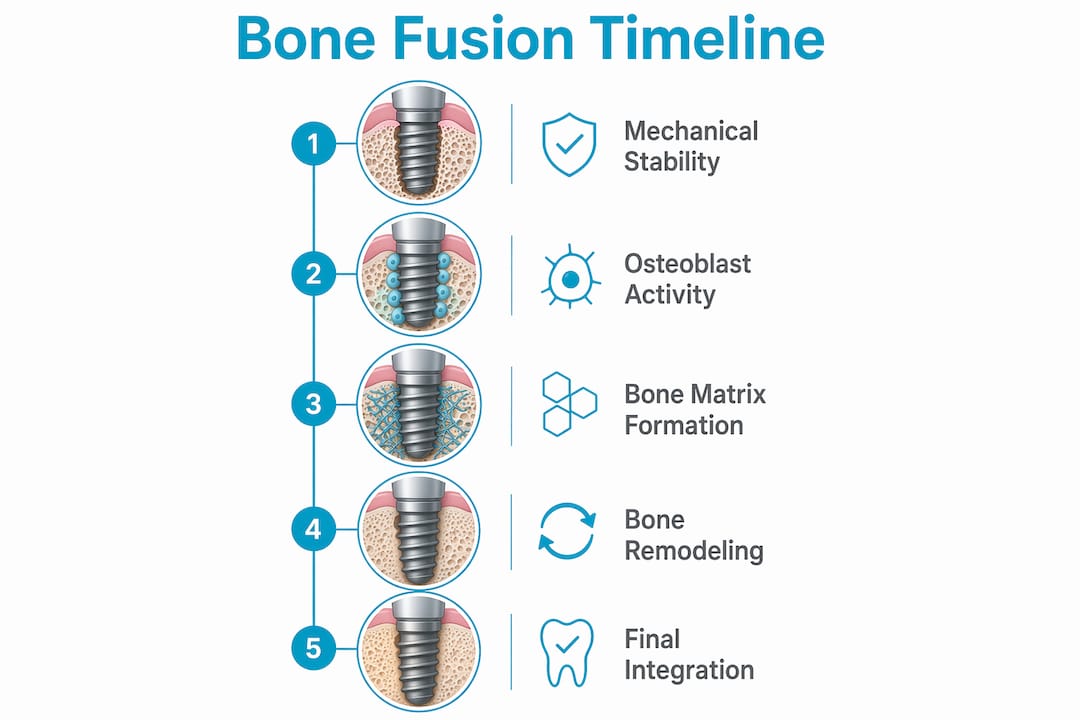
The most critical and least discussed phase is the stability dip. Around weeks 3 to 4 post-surgery, initial mechanical stability decreases before biological stability takes over. During this window, the implant is at its most vulnerable. Chewing on the implant site or trauma to the area can cause failure even when surgery went perfectly.
Several factors influence how quickly and successfully bone heals around an implant:
- Bone density and volume. Dense, healthy bone integrates faster and more reliably than thin or porous bone.
- Systemic health. Conditions like uncontrolled diabetes slow bone healing and raise failure risk.
- Smoking. Smoking restricts blood flow to healing tissue and is one of the most consistent predictors of poor osseointegration.
- Surgical technique. Overheating the bone during drilling damages osteoblasts. Careful, controlled drilling protects the cells that do the healing work.
- Patient compliance. Avoiding hard foods and following post-op care instructions during the stability dip is non-negotiable.
Your dentist confirms successful integration through a combination of clinical testing and imaging before placing the final crown. Placing a crown too early, before the bone has matured, is a preventable cause of implant failure.
How does the immune system affect implant acceptance?
The body’s immune response to a dental implant is not a problem to overcome. It is a process to manage carefully. The body initially treats the titanium implant as a foreign object. This triggers an inflammatory response involving M1 macrophages, which are the immune system’s first responders.
The critical transition happens next. For the implant to succeed, the immune environment must shift from pro-inflammatory to anti-inflammatory. The immune system achieves what researchers call “Foreign Body Equilibrium,” forming a protective bone shell around the implant rather than a fibrous scar capsule. That distinction determines whether the implant integrates or fails.
When M2 macrophages dominate the healing environment, they release IL-10 and TGF-β, cytokines that signal osteoblasts to build bone. When M1 macrophages persist too long, the result is fibrous encapsulation and implant failure. The immune system’s anti-inflammatory shift is not passive. Implant surface design actively encourages it.
Many patients are surprised to learn that implant design modulates the immune response directly. The macro-structure and nano-biochemical signals on the implant surface communicate with both bone cells and immune cells simultaneously. This is why implant selection is a clinical decision, not just a preference.
The good news is that when the immune response is managed well, the hallmark of successful osseointegration is direct bone-to-implant contact with full functional load-bearing capacity. That means the implant can handle the same forces as a natural tooth root.
Key Takeaways
Dental implants fuse to bone through osseointegration, a mechanical interlock driven by osteoblast activity, RUNX2 signaling, and a well-managed immune response across a 3 to 6 month healing window.
| Point | Details |
|---|---|
| Osseointegration is mechanical | Bone grows into implant surface irregularities; no chemical bond is involved. |
| Surface design drives speed | Modified micro-rough surfaces significantly elevate RUNX2 expression and accelerate bone cell attachment. |
| The stability dip is the riskiest phase | Weeks 3 to 4 require strict rest; premature loading at this stage causes preventable failure. |
| Immune balance determines outcome | M2 macrophage dominance over M1 activity predicts successful long-term integration. |
| Total timeline is 4 to 9 months | Osseointegration takes 3 to 6 months; full restoration follows after confirmed bone maturity. |
What 25 years of implant cases has taught me about patience and bone
Patients come to me expecting osseointegration to feel like something. It does not. The bone grows silently, and that silence is often the hardest part for people to trust.
The most common misconception I hear is that once surgery is done, the hard part is over. In my experience, the weeks after surgery are where outcomes are actually decided. I have seen patients with excellent bone density and textbook surgical results lose an implant because they could not resist eating on that side during weeks three and four. The stability dip is real, and it demands real respect.
I also want to be honest about the factors you can control. Quitting smoking before implant surgery is not optional advice. It is the single most impactful lifestyle change a patient can make to protect their investment. Bone health also matters more than most people realize. Patients who maintain adequate calcium and vitamin D levels, manage systemic conditions like diabetes, and keep up with their oral hygiene give their bone the best possible environment to integrate around the implant.
Personalized treatment planning matters too. Not every patient needs the same implant system or the same timeline. At Woodbridgedentalcentre, Dr. Michael Rouhi and Dr. Sandra Farber assess each patient’s bone volume, density, and health history before recommending a path forward. That individualized approach is what separates a good outcome from a great one. The factors behind high success rates are not mysterious. They are the result of careful planning and patient commitment to the healing process.
— Felix
Dental implant care at Woodbridgedentalcentre
Woodbridgedentalcentre serves patients across Woodbridge, Vaughan, and Maple with a full range of dental implant services, from initial consultation through final restoration. Dr. Michael Rouhi and Dr. Sandra Farber guide each patient through every phase of the implant process, including bone grafting when needed, implant placement, and personalized follow-up to confirm osseointegration before crown placement.

The team uses modern surgical techniques and carefully selected implant systems to support healthy bone integration and long-term implant stability. If you are considering tooth replacement and want to understand whether implants are right for your bone health and lifestyle, a consultation at Woodbridgedentalcentre is the right first step. Patients in Woodbridge and Vaughan can book directly through the clinic’s website or by phone.
FAQ
What does osseointegration mean in simple terms?
Osseointegration is the process where your jawbone grows into and mechanically locks around a titanium dental implant. It creates a stable, permanent foundation for an artificial tooth.
How long does it take for a dental implant to fuse to bone?
The bone fusion phase typically takes 3 to 6 months. The full implant process, from placement to final crown, runs 4 to 9 months depending on bone health and healing speed.
What causes a dental implant to fail during osseointegration?
The most common causes are smoking, uncontrolled systemic disease, premature loading during the stability dip at weeks 3 to 4, and insufficient bone volume at the implant site.
Does the body ever reject a dental implant?
Titanium implants are biocompatible and are not rejected the way organ transplants can be. However, if the immune system stays in a pro-inflammatory state too long, fibrous tissue can form around the implant instead of bone, which leads to failure.
Can I speed up bone healing after implant surgery?
You cannot rush osseointegration, but you can protect it. Avoiding smoking, eating soft foods, maintaining good oral hygiene, and following your dentist’s post-op instructions all support the fastest and most reliable healing possible.
Recommended
- Comparing the Different Types of Dental Implant Materials – Woodbridge Dental Centre | Cosmetic, Implant & Family Dentistry
- The Step-by-Step Guide to Getting Dental Implants – Woodbridge Dental Centre | Cosmetic, Implant & Family Dentistry
- Why a Bone Graft Might be Necessary Before Getting Dental Implants – Woodbridge Dental Centre | Cosmetic, Implant & Family Dentistry
- Dental Implants vs. Bridges: Which is Right for You? – Woodbridge Dental Centre | Cosmetic, Implant & Family Dentistry


