The most practical tool you can use in the dentist’s chair right now is slow diaphragmatic breathing, also called belly breathing, paired with a simple paced pattern such as 4-4 or 4-7-8. Breathe in through your nose for four counts, let your belly rise (not your chest), then breathe out slowly for four counts. That single cycle, done in about 15 seconds, activates your parasympathetic nervous system, which lowers heart rate and reduces muscle tension and shifts your body out of the fight-or-flight state that makes dental visits feel so hard.
Here at Woodbridgedentalcentre, we see patients from Woodbridge, Vaughan, and Maple who tell us the chair itself triggers their anxiety before we’ve even started. The good news is that breath control is something you can practice at home and use the moment you sit down. A 2022 feasibility crossover study published in PMC found that diaphragmatic breathing reduced heart rate, lowered perceived pain, and shortened dental visit duration. In my experience, patients who arrive with even a basic breathing plan feel noticeably more in control.
Two quick prompts to start right now:
- Breathe in slowly through your nose, let your belly push outward, hold briefly, then exhale through your nose or slightly parted lips for a count of four.
- If you feel lightheaded at any point, stop the technique, breathe normally, and let your dental team know.
Safety note: If you have asthma, COPD, or a history of fainting, avoid breath-hold techniques until you’ve spoken with your physician. Paced diaphragmatic breathing with no holds is safe for most people, but always tell your dentist about any respiratory condition before you begin.
Does the 4-7-8 method help with sudden anxiety spikes?
Yes, and it’s particularly useful in the moments right before an injection or when you hear the drill start. The 4-7-8 method produces a longer exhale relative to the inhale, which research on breath control links to a faster drop in heart rate than equal-ratio breathing.
Steps for one cycle:
- Close your mouth and inhale quietly through your nose for 4 counts.
- Hold your breath for 7 counts.
- Exhale completely through slightly parted lips for 8 counts.
- That is one cycle. Do one to two cycles before a stressful moment, then return to steady diaphragmatic breathing.
When to choose 4-7-8 vs. steady 4-4 breathing: Use 4-7-8 for a short, acute spike of anxiety, such as the 30 seconds before an injection. Use steady 4-4 diaphragmatic breathing as your baseline rhythm throughout the rest of the visit. Mixing both gives you a quick reset tool and a sustainable background rhythm.
Safety warning: The 7-count breath hold can cause lightheadedness in some people, especially on a first attempt. If you feel dizzy, stop immediately, breathe normally, and signal your dental team. Patients with COPD, asthma, or a history of fainting should skip the hold entirely and use paced 4-4 breathing instead. Check with your physician before trying any breath-hold technique if you have a respiratory condition.
Running one cycle takes less than half a minute. You can complete it silently while the dentist pauses between steps, without interrupting the workflow at all.
How does box breathing help during longer procedures?
Box breathing, also called 4-4-4-4 breathing, gives you a predictable rhythm that’s easy to maintain for 30, 60, or 90 minutes. The equal counts on all four phases, inhale, hold, exhale, hold, create a steady anchor that keeps your attention on your breath rather than the sounds and sensations around you. Canada Dental Advisor recommends it specifically for longer restorative visits.
The four phases:
- Inhale through your nose for 4 counts.
- Hold for 4 counts.
- Exhale through your nose or lips for 4 counts.
- Hold for 4 counts.
- Repeat the cycle continuously.
A simpler 3-3-3 version works well for children or anyone who finds four-count holds uncomfortable. The shorter counts still produce a calming rhythm without the breath-hold intensity of 4-7-8.
To combine box breathing with diaphragmatic technique, let your belly expand on the inhale phase and fall on the exhale. The hold phases are passive, just a gentle pause, not a forced clench.

Pro Tip: If instrument noise breaks your count, use a silent internal mantra on each phase: “in, hold, out, hold.” Some patients ask the dental assistant to count quietly with them during the first few cycles until the rhythm feels automatic. After that, most people can maintain it independently.
How should you practice breathing techniques before your appointment?
Short practice before your appointment makes in-chair breathing feel automatic rather than effortful. Canada Dental Advisor notes that even a single test run increases confidence, and a week of daily practice trains a faster relaxation response. Pair this with dental appointment preparation tips for a complete pre-visit routine.
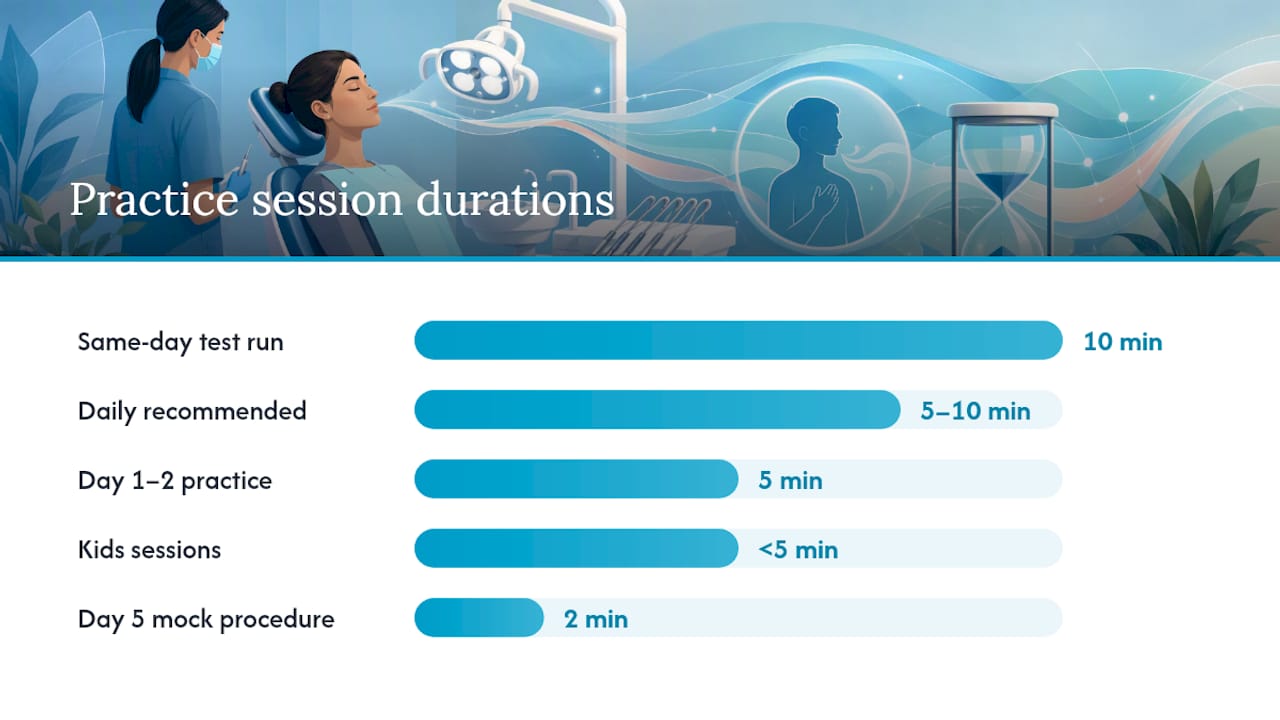
5-day practice plan (5-10 minutes daily):
- Day 1-2: Practice diaphragmatic 4-4 breathing in a reclined position for five minutes. Focus on belly rise, not chest movement.
- Day 3: Add one or two 4-7-8 cycles after your 4-4 warm-up. Note any lightheadedness and shorten the hold if needed.
- Day 4: Try box breathing (4-4-4-4) for five minutes. Add your chosen visualization or mantra.
- Day 5: Run the full sequence in a reclined chair, practice your stop signal (raise your left hand), and time yourself through a two-minute mock procedure.
Same-day test run (10 minutes):
- Sit in a reclined chair or lie on your bed.
- Do five cycles of 4-4 diaphragmatic breathing.
- Try one 4-7-8 cycle.
- Practice raising your left hand as a stop signal.
Practicing with kids: Model the technique yourself first. Children copy what they see. Run through the balloon visualization together and make it a short game rather than a lesson. Keep sessions under five minutes for younger children.
To track progress, rate your calmness on a simple 1-10 scale before and after each practice session. Most patients notice a two to three point drop in perceived anxiety within three to four days of consistent practice.
How do you coordinate breathing with your dental team in the chair?
Agreeing on a stop signal before the procedure starts is one of the most effective things you can do. Knowing you can pause at any moment lowers baseline anxiety before a single instrument is picked up. A private-practice study on coping techniques found that clinicians who support patient-preferred techniques, including agreed signals and pauses, see better cooperation and less distress.
Practical coordination tips:
- Agree the signal — Tell your dentist: “If I raise my left hand, please stop for 30 seconds so I can reset my breathing.” Most dental teams are very comfortable with this.
Pro Tip: Ask your dental team to give you a brief verbal cue before each new step, for example, “I’m going to start the injection now.” That one-second warning gives you time to take a slow breath in before the sensation arrives, which makes a real difference.
Understanding how compassionate dental care works from the clinic side can help you feel more confident asking for these accommodations.
When should you stop breathing techniques and ask for more support?
Breathing techniques are safe for most patients, but there are clear limits. Stop the technique and breathe normally if you experience:
- Dizziness or lightheadedness during any breath-hold phase.
- Tingling in your hands or face (a sign of hyperventilation, slow down your breath rate).
- Chest tightness or shortness of breath.
- A feeling that you might faint.
Signal your dental team immediately if any of these occur. Sit up slowly, breathe at your normal rate, and wait until you feel steady before continuing.
When breathing alone isn’t enough: Severe dental phobia, panic attacks in the chair, or a history of trauma may require more than breath control. Options include nitrous oxide (laughing gas), oral sedation, or a referral to a psychologist who specializes in cognitive behavioral therapy (CBT) for dental fear. These are not signs of failure. They are appropriate clinical tools, and any good dental team will discuss them without judgment.
For patients with asthma, COPD, or a history of syncope, speak with your physician before attempting any breath-hold technique. Gentle paced diaphragmatic breathing with no holds is the safer starting point. When you’re considering sedation dentistry as a complement to breathing techniques, it’s worth reviewing your options with your dentist ahead of time.
What does the research say about breathing and dental anxiety?
The clinical evidence is encouraging, and it’s growing. A 2022 feasibility crossover study (PMC) tested diaphragmatic breathing in a pediatric dental setting and found it reduced heart rate, decreased perceived pain, and shortened overall visit time. The study also confirmed that teaching a single breathing exercise is feasible within a normal clinic workflow, low cost and highly acceptable to patients.
A separate private-practice study (PubMed) examined deep diaphragmatic breathing and focused attention in adult dental patients. It found that patients already use a range of personal coping strategies and that outcomes improve when clinicians actively support those preferences rather than ignoring them.
Key takeaways from the evidence:
- Slow breathing activates the parasympathetic nervous system, reducing the physical stress response.
- Diaphragmatic breathing specifically reduces heart rate and perceived pain in dental settings.
- Clinician support of patient-preferred techniques improves cooperation and reduces distress.
- Even a brief, single-session introduction to breathing in clinic is feasible and well-received.
Harvard Health explains the underlying physiology clearly: breath control gives patients a direct, voluntary way to interrupt the stress response, something that very few other non-pharmacological tools can do as quickly.
When is breathing enough, and when do you need more?
The right approach depends on how much anxiety you’re managing. Three practical decision rules:
- Moderate anxiety (avoidance, white-knuckle visits): Combine breathing with clinic supports such as headphones, topical numbing gel, warmed anesthetic, and milestone pauses. A pre-appointment preparation routine helps significantly here.
In my experience, the majority of patients with mild to moderate anxiety notice a real shift within two to three appointments once they have a consistent breathing plan and a team that respects their stop signal. The goal is never to white-knuckle through it. It’s to build enough comfort that dental care stops feeling like a crisis.
Key Takeaways
Slow diaphragmatic breathing paired with a paced pattern such as 4-4 or 4-7-8 is the most practical, evidence-backed way to reduce anxiety during dental procedures.
| Point | Details |
|---|---|
| Start with belly breathing | Inhale through your nose for 4 counts, belly rises; exhale for 4 counts. Use this as your baseline rhythm. |
| Use 4-7-8 for acute spikes | Inhale 4, hold 7, exhale 8; run one to two cycles before high-stress moments like injections. |
| Practice before your visit | A 5-day plan or a single 10-minute test run makes in-chair breathing feel automatic. |
| Agree a stop signal | Tell your dentist to pause when you raise your left hand; this alone lowers baseline anxiety. |
| Woodbridgedentalcentre supports anxious patients | The team at Woodbridgedentalcentre offers stop signals, milestone pauses, and anxiety-friendly consults for families in Woodbridge, Vaughan, and Maple. |
A dentist’s perspective on breathing and patient comfort
In my experience, the patients who struggle most at the dentist aren’t the ones with the lowest pain tolerance. They’re the ones who feel like they have no control over what’s happening. That’s what breathing gives back: a physical, voluntary way to interrupt the stress response at any moment.
I’ve seen patients who hadn’t been to a dentist in over a decade walk in, use a simple belly-breathing rhythm, and get through a full exam without incident. Not because the fear disappeared, but because they had something concrete to do with it. The breath becomes an anchor.
What I’d encourage every patient to remember is that telling your dental team about your anxiety is never an imposition. At Woodbridgedentalcentre, we work with families across Woodbridge, Vaughan, and Maple who have all levels of dental anxiety, from mild nerves to genuine phobia. We adjust our pace, offer stop signals, use topical numbing before injections, and take the time to explain each step. None of that is extra. It’s just good care.
If breathing techniques alone aren’t getting you there, that’s useful information too. It tells us to look at other supports, not to push through.
Anxiety-friendly dental care at Woodbridgedentalcentre
Patients who use breathing techniques during dental work get the most out of them when their dental team is actively on board. At Woodbridgedentalcentre, we build anxiety-friendly visits into our standard approach for families in Woodbridge, Vaughan, and Maple.

What that looks like in practice: longer consult times for anxious patients, agreed stop signals at every visit, topical anesthetic before injections, headphones if you prefer music or a podcast, and a calm explanation of each step before we begin. For patients who need more, we discuss nitrous oxide and other options without pressure. Whether you’re booking a routine cleaning or a more involved procedure like a root canal or dental restoration, we can tailor the visit to your comfort level.
To request an anxiety-friendly appointment, simply mention it when you call or book online. You can also visit our family dental care page to learn more and book directly. We’re here to make dental care feel manageable, one breath at a time.
Sources and further reading
- Breathing out dental fear: diaphragmatic breathing feasibility crossover study (PMC)
- The effects of deep diaphragmatic breathing and focused attention on dental anxiety in a private practice setting (PubMed)
- Harvard Health — relaxation techniques and breath control
- Canada Dental Advisor — breathing technique guidance
- Tufts Now — how mindfulness can ease dental anxiety
- Best Choice Dental Totowa — mindful breathing techniques for dental anxiety
FAQ
How do you breathe while sitting in the dental chair?
Breathe in through your nose for four counts, letting your belly rise, then exhale slowly for four counts. Keep this steady 4-4 diaphragmatic rhythm between each step of the procedure, switching to normal breathing whenever the dentist needs your full cooperation.
What is the 3-3-3 rule in dentistry?
The 3-3-3 breathing pattern, inhale for 3 counts, hold for 3, exhale for 3, is a simplified paced breathing option often recommended for children or patients who find four-count holds uncomfortable. It produces the same calming rhythm as box breathing but at a gentler pace.
Can dentists tell if you are a mouth breather?
Yes. Dentists routinely notice signs of habitual mouth breathing, including dry oral tissues, a high narrow palate, and specific bite patterns. If you must mouth-breathe during treatment, your dental team can adjust instrument placement and offer short pauses so you can return to nasal breathing between steps.
How do you calm anxiety before dental work?
A short breathing practice the morning of your appointment, five cycles of 4-4 diaphragmatic breathing in a reclined position, reduces baseline anxiety before you arrive. Telling your dental team about your anxiety and agreeing a stop signal when you sit down adds another layer of control that most patients find immediately reassuring.
When should you ask about sedation instead of breathing techniques?
If breathing techniques don’t bring your anxiety to a manageable level after two or three visits, or if you experience panic attacks in the chair, ask your dentist about nitrous oxide or oral sedation. Breathing remains a useful complement to sedation, but it shouldn’t be the only tool for severe dental phobia.
This article provides general information about breathing techniques for dental anxiety and is not a substitute for professional medical or dental advice. Please speak with your dentist or physician about your specific situation.
Recommended
- How Do I Handle My Child’s Fear of the Dentist? | Calming Techniques That Work – Woodbridge Dental Centre | Cosmetic, Implant & Family Dentistry
- Dental Appointment Preparation Tips for Adults
- Why Dental Care Fits Busy Schedules Better Than You Think
- Preparing for Your Dental Implant Surgery: Top Tips – Woodbridge Dental Centre | Cosmetic, Implant & Family Dentistry