

A dental treatment plan is a written, personalized roadmap that documents your oral health status, the procedures your dentist recommends, the sequence those procedures should follow, an estimated timeline, and a breakdown of anticipated costs. It is developed after a thorough clinical evaluation and is meant to guide your care from start to finish.
- What it contains: your diagnosis, a phased sequence of recommended procedures, and a cost estimate so there are no surprises.
- The most important patient takeaway: a treatment plan is a collaborative conversation, not a sales contract. The Royal College of Dental Surgeons of Ontario is clear that plans should be built around shared decision-making, not pressure.
- Your immediate next step: read the plan carefully, ask for plain-language explanations of anything unclear, and know that you are always entitled to a second opinion before proceeding.
What a dental treatment plan includes and why it matters for your care
A written treatment plan typically contains the following core components:
- Patient assessment and diagnosis: a summary of your current oral health, including active disease, risk factors, and clinical findings.
- Treatment objectives: the goals your dentist is working toward, such as eliminating infection, restoring a broken tooth, or stabilizing gum disease.
- Phased sequence of care: the order in which procedures will happen and why that order is clinically important.
- Estimated timeline: a realistic picture of how long each phase will take.
- Materials and options: the type of filling, crown material, or appliance being recommended and any alternatives.
- Risk and benefit notes: what could happen if treatment proceeds, and what could happen if it does not.
- Cost estimate: per-procedure and per-phase pricing so you can plan financially.
- Follow-up schedule: when you return for re-evaluation or maintenance.
The main goals of a well-built dental care plan are to eliminate active disease, relieve pain, restore function, and protect your oral health long-term. From a patient’s perspective, the plan also supports informed decisions, helps you coordinate with your insurance provider, and reduces the chance of unexpected costs mid-treatment.
How your dentist creates your treatment plan
Good treatment planning follows a specific diagnostic sequence. Canadian standards for beginning dental practitioners emphasize comprehensive assessment, a clear problem list, and patient engagement before any recommendation is finalized. Here is what that process typically looks like at your appointment:
- Medical and dental history review. Your dentist asks about medications, systemic conditions, allergies, and past dental experiences. This shapes which treatments are safe and appropriate for you.
- Visual examination. Every tooth, soft tissue, and existing restoration is examined. Your dentist notes decay, cracks, wear, and anything that looks abnormal.
- Periodontal charting. A hygienist or dentist measures the depth of the space between your gum and tooth at six points per tooth. Deeper pockets signal gum disease that must be addressed before restorative work.
- X-rays. Bitewing and periapical radiographs reveal decay between teeth, bone levels, and root health that cannot be seen visually. Cone-beam CT (3D imaging) is added when implants or complex extractions are planned.
- Bite evaluation. How your teeth come together affects which restorations will last and whether jaw pain or wear is a factor.
- Specialist referral or consultation. If a procedure falls outside your general dentist’s scope, such as oral surgery or orthodontics, a referral is requested before the plan is finalized.
You can prepare for this appointment using a dental appointment checklist so you arrive with your medical history and any questions ready.
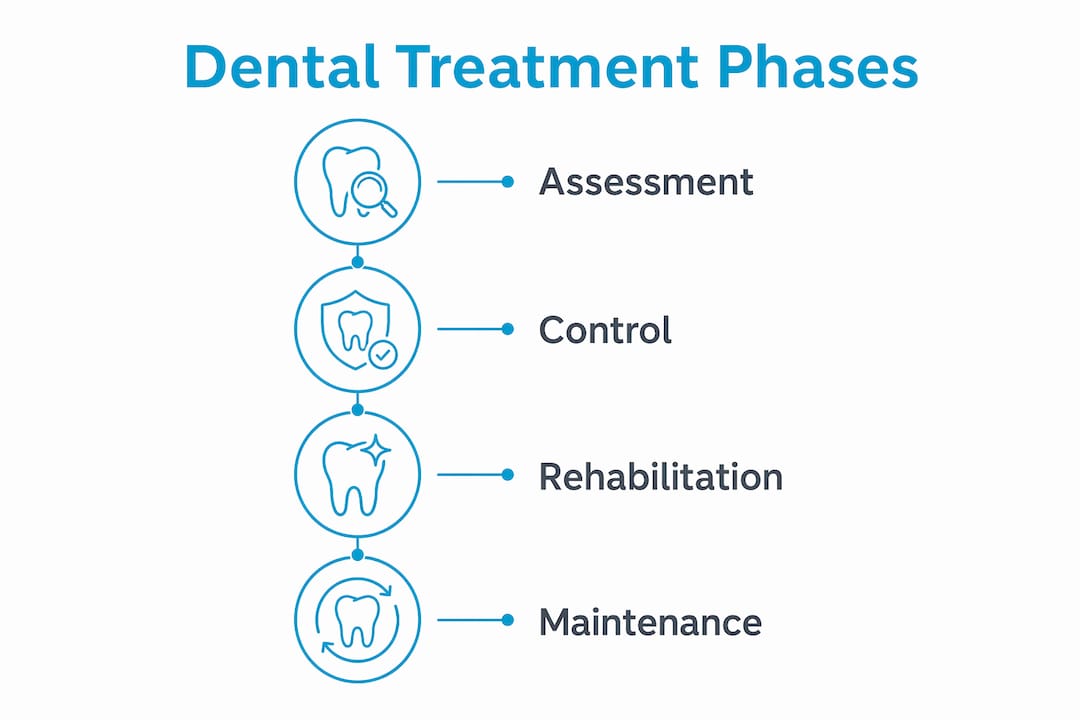
The typical phases of a dental treatment plan and why order matters
Treatment plans are most effective when staged, and the sequence is not arbitrary. Think of it the way you would build a house: you lay the foundation before you put up walls. Controlling infection and gum disease before placing crowns or implants is a biological requirement, not a preference.

| Phase | Primary Goal | Example Procedures |
|---|---|---|
| Control / Acute | Eliminate active disease and pain | Extractions, emergency fillings, scaling and root planing, abscess treatment |
| Re-evaluation / Holding | Assess healing and confirm diagnosis | Periodontal re-charting, updated X-rays, monitoring |
| Definitive / Corrective | Restore function and appearance | Crowns, bridges, dental restorations, implants, orthodontics |
| Maintenance / Supportive | Protect results long-term | Regular hygiene visits, bite checks, periodic exams |
A recommended four-phase approach is widely used in clinical practice, and phases can overlap or be staged across multiple appointments when cost or scheduling requires it. Healing time also affects the calendar: bone grafting before an implant, for example, typically requires several months of healing before the implant post can be placed.
Pro Tip: If your plan skips straight to crowns or implants without addressing gum disease first, ask your dentist to explain why. Healthy gum and bone tissue is the foundation every restoration depends on.
Common procedures you will see on a treatment plan
Recognizing the procedure names on your plan helps you ask better questions. Here is a plain-language guide to the most common items:
- Scaling and root planing (deep cleaning): removes tartar and bacteria from below the gumline to treat gum disease; often the first step in the control phase.
- Fillings: repair cavities by removing decay and placing a tooth-colored or amalgam material to restore the tooth’s shape.
- Root canal treatment: removes infected pulp tissue from inside the tooth to save it from extraction; the tooth is then usually restored with a crown.
- Crowns: cap a damaged or root-canal-treated tooth to restore strength and shape; lab-fabricated and typically require two appointments.
- Bridges: replace a missing tooth by anchoring an artificial tooth to the crowns on adjacent teeth.
- Dental implants: a titanium post placed in the jaw to replace a missing tooth root, followed by a crown; staged over several months to allow osseointegration. Implant risks and considerations are worth reviewing before this procedure.
- Extractions: removal of a tooth that cannot be saved; often planned early so the site can heal before a replacement is placed.
- Dentures (complete or partial): removable appliances that replace multiple missing teeth; partial dentures require healthy abutment teeth for support.
- Periodontal therapy: ongoing treatment for gum disease beyond a standard cleaning, including surgical options in advanced cases.
- Orthodontics: braces or clear aligners such as Invisalign to correct alignment; usually placed in the definitive phase after disease is controlled.
- Preventive hygiene visits: regular cleanings and exams that form the backbone of the maintenance phase.
Items like implants and orthodontics are always staged: implant placement happens first, then the restoration; aligner treatment begins only after any active decay or gum disease is resolved.
How to read your written treatment plan
A clear written plan should specify which teeth are treated using standard tooth numbers, what procedures are planned, anticipated timing, estimated costs, and what happens if the plan changes during treatment. Here is what each section typically covers:
- Patient summary: your name, date, and a brief statement of your oral health status.
- Problem list / diagnosis: the conditions being treated, written in plain language or with a brief explanation.
- Recommended procedures with tooth numbers: each item listed by procedure name and the specific tooth or area involved.
- Sequencing and phases: the order of care and which appointments belong to which phase.
- Estimated timeline: approximate dates or durations for each phase.
- Cost breakdown: per-procedure fees and any phase totals, before and after estimated insurance.
- Alternatives and risks: what other options exist and what the risks of each path are.
- Follow-up schedule: when your next re-evaluation or maintenance visit is expected.
A treatment plan that lists procedures without tooth numbers, skips alternatives, or pressures you to sign on the spot is missing the transparency you deserve. Ask for a plain-language version, request a copy for your records, and take it home before signing if you need time to think.
Red flags to watch for:
- Vague descriptions with no tooth numbers or procedure codes.
- No mention of alternatives or what happens if you decline a procedure.
- Missing timeline or cost estimate.
- Pressure to sign and schedule immediately without explanation.
You are always entitled to a copy of your plan. Keep it for insurance coordination or if you seek a second opinion.
Realistic timelines and an honest look at costs and insurance in Canada
How long a plan takes depends entirely on what it includes. A single filling can be completed in one appointment. A plan involving multiple restorations may span several months. Full-mouth rehabilitation with implants can take a year or more, largely because of biologic healing requirements such as osseointegration after implant placement.
| Case Type | Typical Duration | Key Factor |
|---|---|---|
| Single filling or extraction | 1–2 appointments | Straightforward; minimal healing time |
| Multiple restorations (crowns, fillings) | 2–6 months | Lab fabrication, phased scheduling |
| Implant placement and restoration | 6 months | Osseointegration and bone healing |
| Full-mouth rehabilitation | several months or more | Phased disease control, healing, and restoration |
For a more detailed breakdown, the dental treatment timeline resource at Woodbridgedentalcentre walks through what to expect at each stage.
Managing costs and insurance in Canada:
- Pre-authorization: for major procedures, submit a pre-authorization request to your insurer before treatment begins. The Canadian Dental Care Plan (CDCP) has specific documentation requirements for services like crowns, dentures, and scaling that differ from private insurance plans.
- Coordinate benefits: if you and your spouse both have coverage, coordinating benefits can significantly reduce your out-of-pocket costs.
- Phase treatment across benefit years: splitting a large plan across two calendar years can maximize annual insurance limits.
- Ask about financing: many clinics offer third-party financing plans that spread costs over monthly payments with no or low interest.
- Get a written estimate: always request a written fee estimate before treatment starts so you know your expected share.
Breaking comprehensive plans into stages is one of the most practical ways to coordinate treatment with insurance and reduce surprise costs.
What signing a treatment plan actually means
Signing a treatment plan documents that you understand the recommended care and the reasons for it. According to the American Dental Association, your signature indicates informed consent but does not legally obligate you to proceed with treatment immediately or at all.
- Informed consent means: you acknowledge that you have been told what is recommended, why it is recommended, what the risks are, and what alternatives exist.
- It does not mean: you are locked into a schedule, a payment, or a specific procedure.
- Can you change your mind? Yes. You can decline a procedure, request a different option, or pause treatment at any point.
- Can you seek a second opinion? Always. Ask for a copy of your records, X-rays, and the written plan. Any licensed dentist in Canada can review them.
- What to do before signing: read the full plan, ask for plain-language explanations of anything unclear, and request a copy to take home if you need time.
Building trust in your dental care is a two-way process. A dentist who respects informed consent will welcome your questions, not rush you past them.
Questions to ask at your appointment and how to prioritize treatments
Patients who understand why a step is needed are more likely to follow through and achieve better long-term outcomes. Bring this list to your next appointment:
- What is the diagnosis for each item on this plan? Ask for the specific condition being treated, not just the procedure name.
- What are my alternatives? Every recommendation should come with at least one alternative, including the option of monitoring rather than treating immediately.
- What happens if I wait? Some conditions worsen quickly; others are stable. Knowing the risk of delay helps you prioritize.
- What will this cost me after insurance? Ask for a written estimate that separates the fee from your estimated coverage.
- Can this be staged across appointments or benefit years? Most plans can be phased to fit your schedule and budget.
- What is the expected outcome and how long will it last? Realistic expectations prevent disappointment later.
A simple three-step prioritization framework:
- Address pain and infection first. Any abscess, acute pain, or active infection takes priority regardless of cost or convenience.
- Stabilize disease. Gum disease and active decay must be controlled before restorations are placed. Skipping this step shortens the life of any crown or implant.
- Plan restorations for function and longevity. Once the mouth is stable, work through restorative and cosmetic items in an order that makes biological and financial sense.
Your cosmetic dentistry consultation checklist is a useful companion if your plan includes appearance-related work.
Digital tools and visuals you may see in a modern treatment plan
Many clinics now use digital tools to make treatment plans clearer and easier to understand. Common options include:
- Clinical photographs: before-and-after images of your teeth that document current conditions and help you see what is being treated.
- Digital impressions: a wand-based scanner replaces traditional putty molds, producing a 3D model of your teeth on screen.
- Cone-beam CT (CBCT): a 3D X-ray used when implants, bone grafts, or complex extractions are planned; gives your dentist a precise view of bone volume and anatomy.
- Treatment simulation visuals: some software can show an approximate preview of restorative or orthodontic outcomes.
- Patient portal access: online portals let you view your records, treatment notes, and upcoming appointments from home.
Digital treatment plans and visual tools help patients understand their options and improve documentation for insurance or specialist referrals. Ask your clinic: “Will I receive copies of my photos or scans?” and confirm how your records are stored and who can access them. In Canada, your dental records belong to you, and you have the right to request copies.
What to expect when Woodbridgedentalcentre prepares your treatment plan
At Woodbridge Dental Centre, the process follows a clear, patient-centered workflow led by Dr. Michael Rouhi, Dr. Sandra Farber, and their team:
- Initial exam and records: a comprehensive exam including X-rays, periodontal charting, and clinical photographs is completed at your first visit.
- Treatment discussion with options: your dentist walks through findings with you, explains each recommendation, and presents alternatives so you can make an informed choice.
- Written plan provided: you receive a written plan with procedure names, tooth numbers, phased sequencing, and a cost estimate before any treatment begins.
- Phased scheduling and financing discussion: the team works with you to stage care across appointments and benefit periods, and can discuss financing options that fit your situation.
- Follow-up schedule: re-evaluation appointments are built into the plan so your progress is monitored at every phase.
Families across Woodbridge, Vaughan, and Maple trust the clinic for honest, unhurried treatment planning. The focus is always on long-term oral health, comfort, and giving you the information you need to make decisions that are right for you.
Pro Tip: Bring a list of your current medications and any dental insurance cards to your first appointment. Having that information ready lets your dentist and the front desk team build your plan and estimate your coverage in the same visit.

Key Takeaways
A dental treatment plan is a written, personalized roadmap that organizes your diagnosis, the sequence of recommended care, and estimated costs so you can make informed decisions and avoid surprises.
| Point | Details |
|---|---|
| What the plan is | A written document covering diagnosis, phased procedures, timeline, and cost estimate. |
| Why sequencing matters | Disease and infection must be controlled before restorations like crowns or implants are placed. |
| Your rights as a patient | Signing means informed consent, not a binding obligation; you can ask questions or seek a second opinion at any time. |
| Managing costs in Canada | Stage treatment across benefit years, use pre-authorization for major work, and ask about financing options. |
| Woodbridgedentalcentre’s approach | Dr. Rouhi, Dr. Farber, and their team provide written plans with phased scheduling and financing discussions for families in Woodbridge, Vaughan, and Maple. |
A dentist’s perspective on treatment planning
In my experience, the patients who feel most confident about their dental care are the ones who actually understand their plan. Not just the procedure names, but the why behind the sequence. Many patients are surprised to learn that a crown placed over untreated gum disease will likely fail within a few years, not because the crown was poorly made, but because the foundation was never stable. That is why we spend time at the control phase before moving forward, even when a patient is eager to get to the cosmetic work.
The good news is that a clear, honest treatment plan removes most of the anxiety around dental care. When you know what is coming, when it is coming, and roughly what it will cost, the whole process feels manageable rather than daunting. Families in Woodbridge, Vaughan, and Maple who come to us often say the same thing after their first planning appointment: they wish they had asked for a written plan years earlier.
The right treatment depends on the cause, and the right plan depends on the person. That is what makes treatment planning a conversation, not a prescription.
Clear treatment plans, close to home in Woodbridge and Vaughan
Patients in Woodbridge, Vaughan, and Maple who want a clear, written plan without pressure will find that Woodbridge Dental Centre is built around exactly that. The clinic offers comprehensive exams, written treatment plans with phased scheduling, and open conversations about financing and insurance coordination before any treatment begins.

Dr. Michael Rouhi, Dr. Sandra Farber, and their team serve families of all ages, from children’s first visits to full restorative care for adults. Every plan comes with plain-language explanations, written cost estimates, and the time to ask every question on your list. You are never rushed to sign, and a second opinion is always respected.
To get started with a family dental care appointment and a written treatment plan tailored to your needs, contact Woodbridge Dental Centre to book your comprehensive exam.
Useful sources for Canadian patients
These authoritative resources can help you verify standards, understand your rights, and learn more about specific procedures:
- Royal College of Dental Surgeons of Ontario (RCDSO): the provincial regulator for dentistry in Ontario. Their guidance on diagnosis and treatment planning outlines what patients should expect from a compliant, ethical planning process.
- Canadian Dental Care Plan (CDCP) preauthorization resources: if you are enrolled in the federal CDCP, this page explains which procedures require pre-authorization, what documentation is needed, and how coverage criteria differ from private insurance.
- Woodbridge Dental Centre patient resources: clinic-specific pages covering services, timelines, and patient education articles to help you prepare for appointments and understand your options.
Regulatory bodies and clinic resources serve different purposes. Use the RCDSO and CDCP pages to understand your rights and coverage rules, and use clinic resources to prepare for your specific appointment and ask better questions.
FAQ
What is included in a dental treatment plan?
A dental treatment plan includes your diagnosis, a list of recommended procedures with tooth numbers, the sequence and phases of care, an estimated timeline, a cost breakdown, alternatives, and a follow-up schedule. It is based on a comprehensive clinical evaluation that typically includes X-rays, periodontal charting, and a visual exam.
What does signing a dental treatment plan mean?
Signing documents your informed consent: you acknowledge that you understand the recommended care, the reasons for it, and the alternatives. It does not legally obligate you to proceed with treatment immediately or at all.
Can I get a second opinion after receiving a treatment plan?
Yes, always. Ask for a copy of your written plan, X-rays, and clinical records; any licensed dentist in Canada can review them. Seeking a second opinion is a recognized patient right and a reasonable step for any significant or costly recommendation.
How long does a dental treatment plan take to complete?
It depends on the complexity of your care. A single filling takes one appointment; a plan involving multiple crowns may span several months; implant treatment typically takes several months due to healing and osseointegration requirements.
How does the Canadian Dental Care Plan affect my treatment plan?
If you are enrolled in the federal CDCP, certain procedures such as crowns, dentures, and additional scaling units require pre-authorization with specific supporting documentation. CDCP coverage criteria are more stringent than most private plans and focus on treatments that address active biological disease.


